
IPO Listing Date Calendar 2026: Tracking New Stock Debuts in India
By IPO Plus
Stay ahead with our 2026 ipo listing date calendar for India. Track all new stock debuts, master the T+3 timeline, and plan your exit strategy with precision.

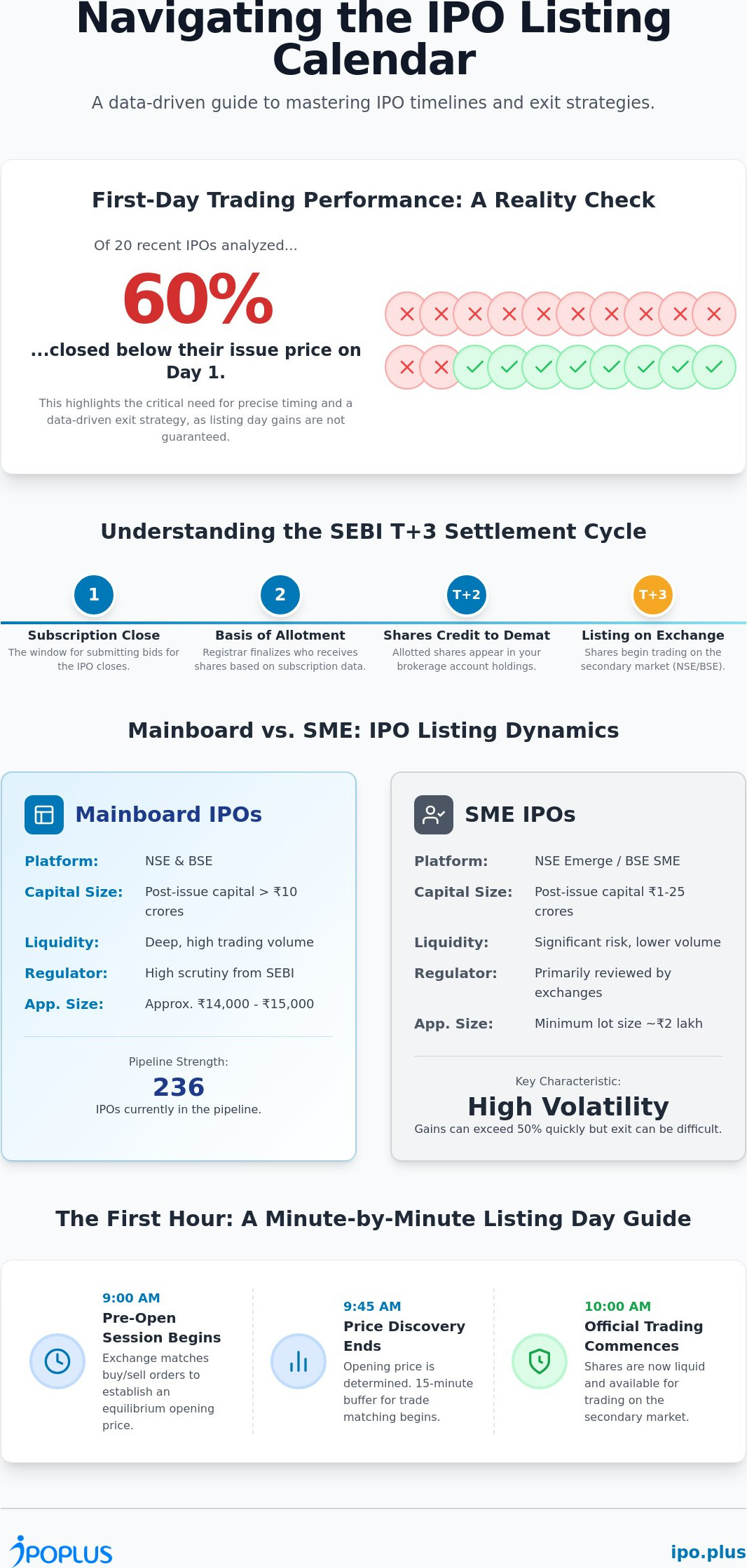
Of the 20 IPOs listed by June 2, 2026, 12 ended their first trading day below the issue price. This data highlights why a precise ipo listing date calendar is necessary for successful exit execution. Missing a debut date often results in poor timing and lost liquidity. Most investors find it difficult to track the rapid shift from subscription to trading under the current T+3 settlement cycle.
We provide the data to manage these timelines with precision. This guide tracks every upcoming listing date and clarifies the SEBI-mandated T+3 process. You'll see exactly when shares hit your demat account at T+2 and when trading begins at T+3. This clarity is essential for planning a disciplined market exit strategy.
We examine the 236 mainboard IPOs currently in the pipeline. We also provide specific details on SME listing volatility and anchor investor lock-in periods. This ensures your participation in the 2026 market remains methodical and data-driven.
Key Takeaways
- Master the ipo listing date calendar to monitor official debuts and avoid missing the critical 10:00 AM trading commencement.
- Execute the T+3 settlement timeline with precision, tracking the transition from subscription close to demat credit at T+2.
- Develop data-driven exit strategies using subscription metrics and GMP trends to manage listing day price volatility.
- Distinguish between Mainboard and SME listing dynamics on NSE Emerge and BSE SME platforms for better capital management.
- Monitor real-time status updates and listing alerts through the IPO Plus Dashboard and mobile application.
What is an IPO Listing Date Calendar?
An ipo listing date calendar is a specialized financial tool used to monitor the transition of private companies into publicly traded entities. The listing date marks the official debut on stock exchanges. It represents the first time shares are available for secondary market participants. To understand the broader context of What is an Initial Public Offering, it's helpful to see listing as the culmination of the subscription and allotment phases. Without a centralized calendar, investors risk missing the exact moment a stock becomes tradable.
The listing process follows a strict chronological order. It begins with the pre-open session at 9:00 AM on the debut day. During this window, the exchange matches buy and sell orders to establish an opening price. Official trading starts at 10:00 AM. A reliable ipo listing date calendar tracks this entire sequence from the subscription close to the first tick on the exchange. Accurate data prevents the common mistake of attempting to sell shares before they're credited to the demat account. It ensures you're ready for the 10:00 AM bell.
The Importance of Timing in IPO Trading
Listing day volatility is typically the highest in a stock's lifecycle. Price discovery occurs between 9:00 AM and 9:45 AM. This period determines the opening price based on demand and supply. Retail investors often focus on listing gains. These gains occur if the opening price is higher than the issue price. Precise timing is required to execute exit orders during the initial surge. The 15-minute buffer between 9:45 AM and 10:00 AM is reserved for trade matching. Listing dates also signal when shares become liquid. You can't trade until the exchange activates the ticker.
Key Components of a Market Calendar
Effective tracking requires monitoring four specific markers. The Issue Open and Close dates define your subscription window. The Basis of Allotment date follows. This is the stage where the registrar finalizes who receives shares. It's a critical prerequisite for the credit of shares, which usually happens by T+2. Finally, the Listing Date marks the start of secondary market trading. A complete calendar aggregates these data points for every active IPO. It serves as a roadmap for liquidity management and risk assessment. It keeps you informed of status changes in real time.
- Issue Window: Defined period for submitting bids.
- Allotment Status: Confirmation of share assignment.
- Demat Credit: Shares appear in your holdings.
- Listing Debut: Trading begins on NSE/BSE.
Mainboard vs. SME IPO Listing Dynamics
Mainboard and SME IPOs follow distinct listing paths. Investors must distinguish between these segments to manage liquidity expectations. Mainboard issues list on the NSE and BSE simultaneously. SME issues list on specialized platforms like NSE Emerge or BSE SME. This structural difference dictates trading volume and investor participation from the opening bell. Understanding these variables helps in interpreting the ipo listing date calendar with greater accuracy.
Listing on National Exchanges
Mainboard IPOs target established corporations. These companies have a post-issue capital exceeding ₹10 crores. Institutional and global investors provide the primary demand. This participation ensures deep liquidity from the first minute of trading. Successful large-cap debuts often move toward index inclusion in subsequent quarters. Reviewing the mainboard ipo list 2024 reveals how these stocks maintain price stability post-debut. The ipo listing date calendar for mainboard issues is typically more predictable due to higher regulatory scrutiny from SEBI. Data from the first five months of 2026 shows 22 companies raised over ₹20,581 crore. This volume indicates a robust pipeline for the mainboard segment despite selective investor sentiment.
The SME Segment Listing Process
SME IPOs serve small to medium enterprises with post-issue capital between ₹1 crore and ₹25 crores. These listings occur on dedicated SME exchanges. The regulatory path is less rigorous. Stock exchanges act as the primary reviewers rather than SEBI directly. The sme ipo list india highlights opportunities in niche manufacturing and service sectors. Listing day performance is often volatile. Gains can exceed 50% quickly due to the small share float. However, liquidity remains a significant risk. Investors often face difficulty exiting positions if demand drops post-listing because there are fewer active buyers compared to the mainboard.
Segment dynamics vary by lot size and capital requirements. Mainboard applications require approximately ₹14,000 to ₹15,000. SME applications require a minimum of ₹2 lakh. This high entry barrier limits the number of retail participants. Trading occurs in predefined lots rather than single shares. This structure results in lower secondary market volumes. A comprehensive ipo listing date calendar tracks both segments to help investors allocate capital efficiently. Understanding these variables is critical for exit planning. Recent 2026 statistics show subdued performance. By June 2, 2026, 12 of 20 listed IPOs traded below their issue price. This trend emphasizes the need for disciplined tracking. You can monitor all active filings through the IPO Tracking Dashboard for real-time debut alerts.
Analyzing Listing Date Volatility and Exit Strategies
Listing day performance is often decoupled from long-term fundamentals. It's driven by immediate sentiment and liquidity. An ipo listing date calendar serves as the countdown for these high-velocity events. High subscription figures, especially in the retail and HNI categories, usually signal a strong debut. However, subscription data alone isn't a guarantee of sustained gains. Traders must monitor the 9:00 AM pre-open session to identify the equilibrium price before the 10:00 AM bell. This 45-minute window is the most critical period for price discovery.
Using GMP to Predict Listing Day Action
Grey Market Premium (GMP) acts as an informal demand gauge. It represents the premium investors pay over the issue price in the unregulated market. Comparing the ipo listing date calendar with daily GMP trends helps set realistic target sell prices. A stable or rising GMP indicates sustained interest. Conversely, a sharp decline 24 hours before listing often signals institutional caution. Traders use this data to decide between selling at the open or holding for discovery. GMP is a sentiment indicator, not a regulated price floor, so it should be used alongside official subscription metrics.
Post-Listing Liquidity and Trading Volumes
The first 15 minutes of trading are the most volatile. This window sees the highest volume as institutional investors often engage in flipping. This practice involves selling allotted shares immediately to capture quick gains. This sudden supply can trigger price corrections shortly after 10:00 AM. Circuit filters also play a role. On the listing day, mainboard stocks don't have standard circuit limits during the pre-open session. This allows for extreme price movement. SME IPOs typically have a 5% cap once trading commences. Monitoring these filters is essential for executing limit orders effectively.
Choosing between partial profit booking and long-term holding depends on your risk profile. Selling 50% of your allotment at the open locks in capital. It leaves the remaining half to capture potential upside. Long-term holders should ignore listing day noise. They focus instead on the company's growth trajectory post-listing. Use your tracking tools to set reminders for anchor investor lock-in expiry dates. These milestones often trigger secondary sell-offs. A disciplined exit strategy prevents the common mistake of holding a "listing gain" play until it turns into a long-term loss.
- Partial Booking: Sell half at the open to recover the initial investment.
- Stop-Loss: Set a mental or system-based exit point below the opening price.
- Volume Check: High delivery percentages indicate long-term institutional interest.
- Lock-in Alerts: Track 30-day and 90-day windows for anchor exits.
T-Day represents the final date for IPO subscriptions. Once the window closes, the registrar begins the reconciliation process. T+1 marks the finalization of the basis of allotment. This stage confirms if you've received shares or if your blocked funds will be released. By T+2, the registrar initiates refunds and credits shares to demat accounts. Trading officially commences on T+3. This rapid progression minimizes the time capital remains idle. It allows traders to redeploy funds into new opportunities faster than ever before.
The Role of Registrars in the Timeline
Registrars like Link Intime or KFin Technologies act as the primary processors. They manage the technical aspects of the allotment. They ensure the distribution complies with SEBI's category-wise rules for Retail, HNI, and QIB segments. Any reconciliation errors at the registrar level can delay the entire ipo listing date calendar. Investors should monitor the registrar's portal for real-time allotment status. Always verify the official listing circular on the BSE or NSE websites to confirm the debut date. These circulars provide the final confirmation of the trading symbol and series.
Ensuring Your Demat is Ready
Trading cannot occur if shares aren't visible in your holdings. Shares must be credited to your demat account before the 9:00 AM pre-open session on T+3. Selecting the best demat account for ipo ensures that these credits occur without technical glitches. Most modern brokers show allotted shares as unlisted assets on the evening of T+2. Check your portfolio status before the market opens to ensure your exit strategy is executable. If shares don't appear by T+2 midnight, contact your Depository Participant immediately.
Track every stage of the T+3 cycle with our IPO Tracking Dashboard for real-time status updates. This ensures you never miss a debut or a refund milestone.
- T-Day: Subscription window closes at 5:00 PM.
- T+1: Allotment status finalized and published.
- T+2: Shares credited to demat; funds unblocked for non-allottees.
- T+3: Official listing at 10:00 AM on exchanges.
Real-Time Tracking with the IPO Plus Dashboard
Managing multiple IPO applications requires a centralized data hub. The ipo listing date calendar on our dashboard aggregates disparate exchange circulars into a single, functional interface. It eliminates the need for manual tracking across multiple exchange websites. Real-time updates ensure you receive listing date announcements the moment they're finalized. This speed is critical for executing the T+3 strategies discussed in earlier sections. You can access the most accurate ipo tracking app india to monitor the 2026 pipeline with precision.
The dashboard integrates live Grey Market Premium (GMP) data directly with the ipo listing date calendar. This side-by-side view allows for immediate assessment of listing day expectations. When a listing date is confirmed, the system automatically cross-references it with current subscription levels. This provides a comprehensive outlook on potential volatility. Given that 12 out of 20 IPOs traded below issue price by mid-2026, having this data centralized is a significant advantage for risk management. It ensures your exit strategy is based on real-time variables rather than outdated information.
Features of the IPO Plus Calendar
The dashboard provides granular control over market data. Users can filter listings by Mainboard or SME segments to match their specific investment criteria. Each entry includes direct links to registrar portals like Link Intime or KFintech. This integration removes friction from the T+1 and T+2 verification stages. We also maintain historical performance records for recently listed entities. This data allows for comparative analysis of debut trends against current market conditions. For investors seeking early opportunities, we provide a detailed pre ipo stock list india. These early signals help identify the next big market entrants before they file formal draft papers.
Stay Updated on the Go
Market movements occur rapidly. The IPO Plus Android app delivers push notifications for every critical milestone. You'll receive alerts for subscription closes, allotment finalizations, and debut dates. This proactive system prevents the risk of missing a 10:00 AM trading commencement. The app also features a community section where investors discuss listing day sentiment and exit timing. It's a methodical way to stay informed without constant manual checking of exchange circulars. Our tool acts as a vigilant observer. It ensures your market participation is backed by the latest data-driven insights.
- Automated Alerts: Instant notifications for listing date changes and updates.
- Integrated GMP: Live premium tracking alongside official debut dates.
- Direct Allotment Links: Rapid access to registrar portals for status checks.
- Segment Filtering: Toggle between NSE Emerge, BSE SME, and Mainboard views.
Streamline your 2026 investment workflow. Download the IPO Plus Android App today for real-time market tracking and comprehensive data analysis.
Execute Your 2026 Market Entry with Precision
Precision in tracking the T+3 settlement cycle is now the standard for Indian investors. With the 2026 pipeline showing hundreds of potential debuts, your reliance on an accurate ipo listing date calendar determines your ability to capture listing gains. Tracking the transition from T-Day to the 10:00 AM debut ensures you don't miss critical liquidity windows. It's the difference between a disciplined exit and a missed opportunity.
Efficient exit planning depends on real-time data integration. Monitoring live subscription figures and GMP shifts allows you to adjust your sell targets as the listing date approaches. This methodical approach is essential for navigating both SME volatility and mainboard liquidity. You'll find that staying organized is the most effective way to manage market risk.
Download the IPO Plus App for Real-Time Listing Alerts for access to real-time GMP data, live subscription tracking, and comprehensive SME and mainboard coverage. Centralizing your market research empowers you to act with speed and accuracy. Prepare your portfolio for the next big debut and stay ahead of the curve.
Frequently Asked Questions
What does T+3 listing mean in the Indian stock market?
T+3 refers to the mandatory timeline where a company must list on stock exchanges within three working days of the IPO subscription closing. T represents the closing date. Under this SEBI mandate, allotment happens on T+1, share credit occurs on T+2, and trading begins on T+3. This cycle ensures faster access to liquidity for all participants.
Can the listing date of an IPO be changed after the issue closes?
Yes, listing dates can shift due to technical reconciliation issues or regulatory requirements. While the T+3 cycle is the standard, registrars or exchanges may issue revised circulars if delays occur during the allotment phase. Investors should monitor real-time status updates on their ipo listing date calendar to stay informed of any schedule adjustments.
How can I check the official listing date of an SME IPO?
Official dates for SME issues are published in listing circulars on the BSE SME or NSE Emerge websites. These platforms operate dedicated segments for small and medium enterprises. You can also track these specifically by filtering for the SME segment on a centralized ipo listing date calendar to avoid missing niche market debuts.
What time does an IPO stock start trading on the listing day?
Official trading for a new IPO begins at 10:00 AM. Before this, a pre-open session for price discovery takes place between 9:00 AM and 9:45 AM. The period from 9:45 AM to 10:00 AM is reserved for order matching. Once the 10:00 AM bell rings, the stock enters the continuous trading session on the secondary market.
Do I need to do anything after allotment to get shares by the listing date?
No manual intervention is necessary after you receive an allotment confirmation. The registrar is responsible for the electronic credit of shares directly to your demat account by the T+2 deadline. You should simply verify that the shares are visible in your holdings before the 9:00 AM pre-open session on the debut day.
Why is the listing price different from the IPO issue price?
The listing price is determined by market forces during the pre-open discovery session. High demand relative to the share supply results in a listing premium. Conversely, weak investor sentiment can lead to a discount. This price represents the market's immediate valuation of the company's prospects at the moment of its public debut.
Where can I find the listing date calendar for all 2026 IPOs?
The IPO Plus Dashboard maintains a comprehensive ipo listing date calendar for all 2026 market entrants. It aggregates data for both Mainboard and SME segments into a single interface. The tool provides real-time alerts for debut dates, ensuring you have the latest data for your market exit strategies and capital allocation.
What happens if the listing date falls on a bank holiday?
If a scheduled listing date coincides with a bank or exchange holiday, the debut is postponed to the next working day. The T+3 settlement cycle only counts days when the NSE and BSE are open for active trading. Weekends and declared market holidays are excluded from the three-day countdown from the subscription close.