
Pre-IPO Stock List India 2026: Tracking the Next Big Market Entrants
By IPO Plus
Get our definitive pre ipo stock list india for 2026. Track high-potential companies like NSE & Zepto and navigate SEBI regulations before they go public.

Pre-IPO tracking is the early warning system for Mainboard success; if you aren't watching the unlisted pipeline, you're already late to the IPO. You likely find the unlisted market opaque and difficult to navigate. Information asymmetry makes tracking DRHP filings a constant challenge for many investors. Our guide simplifies this process by providing a definitive pre ipo stock list india for 2026. We identify high-potential companies like NSE, Zepto, and Hero FinCorp before they reach the mainboard.
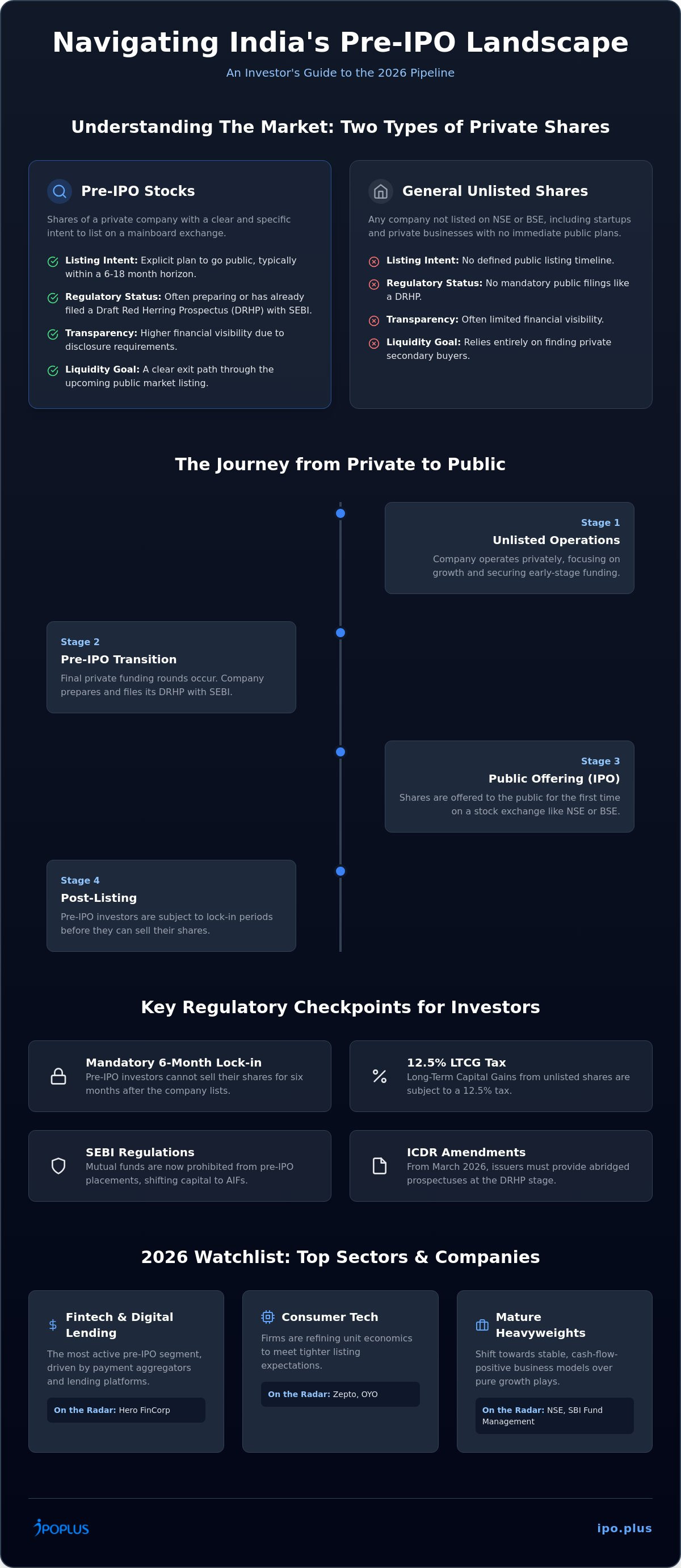
Understanding the transition from private to public is critical for market timing. Recent SEBI changes now prohibit mutual funds from pre-IPO placements. Capital is shifting toward Alternative Investment Funds. March 2026 ICDR amendments require issuers to provide abridged prospectuses at the DRHP stage. Investors must also account for the mandatory 6-month lock-in period and the 12.5% long-term capital gains tax. This article clarifies the roadmap for upcoming contenders. It provides the data-driven insights and tools you need to track listing progress and regulatory compliance effectively.
Key Takeaways
- Distinguish between general unlisted shares and pre-IPO stocks based on their specific intent to list on the mainboard.
- Identify high-potential contenders for 2026 within our comprehensive pre ipo stock list india covering fintech and tech sectors.
- Master DRHP analysis techniques to evaluate company financials and the pedigree of existing venture capital backers.
- Navigate SEBI regulations including the mandatory 6-month lock-in period and current tax implications for unlisted shareholdings.
- Utilize the IPO Plus Dashboard to monitor real-time listing progress and compare indicative prices with live Grey Market Premium data.
What are Pre-IPO Stocks in India? Understanding the Unlisted Market
Pre-IPO stocks represent the shares of a private company currently transitioning toward a public listing. These securities serve as the final private funding stage before an exchange listing. Companies utilize these rounds to establish valuation benchmarks and price discovery before filing their Draft Red Herring Prospectus (DRHP). While all pre-IPO stocks are unlisted, not all unlisted shares qualify as pre-IPO. The primary differentiator is the explicit intent to list on a recognized stock exchange within a foreseeable timeframe.
Monitoring a pre ipo stock list india allows traders to observe the final capital infusion rounds. These rounds often involve institutional investors or high-net-worth individuals. The goal is to provide a bridge to the public markets. This stage is critical for setting the initial price band expectations. It offers a glimpse into how the market values the company's growth trajectory before the general public gains access. It's the last opportunity for private entry.
Pre-IPO vs. Unlisted Shares: The Key Differences
The distinction between these two categories depends on the listing timeline and regulatory status. Unlisted shares include any company not on the NSE or BSE. This includes small family businesses or early-stage startups with no immediate plans to go public. Pre-IPO stocks have a specific 6 to 18 month horizon to listing. This narrow window attracts different types of capital and risk profiles. Timing is the differentiator.
Regulatory filings provide another layer of separation. Companies in the pre-IPO phase are usually preparing or have already submitted their DRHP to SEBI. This filing increases transparency and provides detailed financial disclosures. Pre-IPO investing relies on these documents for due diligence. In contrast, standard unlisted companies may offer limited financial visibility. Liquidity also differs significantly. Pre-IPO investors anticipate a clear exit through the public market, whereas unlisted share liquidity depends entirely on private secondary buyers.
Why Investors Track the Pre-IPO Pipeline
Early discovery remains the primary driver for tracking these companies. Investors look for market leaders in high-growth sectors like SaaS, fintech, and green energy. Identifying these firms before they become household names allows for early position building. It provides exposure to sectors that may not yet be well-represented on the mainboard. It's about finding the next market leader.
Valuation arbitrage is another major factor. There's often a price gap between the final private round and the eventual IPO listing price. Investors seek to capture this delta. Historical data from the mainboard ipo list 2024 shows how sector performance in the public market influences private valuations. By tracking the pre ipo stock list india, investors can spot emerging trends before they dominate the broader market. This proactive approach helps in understanding which business models are gaining traction with institutional backers.
The Pre-IPO Stock List India 2026: Top Sectors to Watch
The 2026 pipeline marks a significant transition in the Indian unlisted market. Investors are shifting focus from cash-burning startups to profitable technology and advanced manufacturing entities. This evolution is visible in the current pre ipo stock list india, which features mature heavyweights like the National Stock Exchange (NSE) and SBI Fund Management. These companies reflect a broader market preference for stable, cash-flow-positive business models over pure growth plays. Consumer tech firms like Zepto and OYO are also refining their unit economics to align with these tighter listing expectations for 2026.
Manufacturing is gaining momentum due to supply chain diversification. Infrastructure companies supporting India's energy transition are now staple entries on tracking lists. The regulatory environment is also maturing. The March 21, 2026, ICDR amendments now require an abridged prospectus at the DRHP stage. This provides earlier visibility into financial health, helping investors assess contenders before the public issue. You can monitor these sector-specific movements and filing statuses through the IPO Tracking Dashboard to maintain a data-driven edge.
Fintech and Digital Lending Pipeline
Fintech remains the most active pre-IPO segment. Digital lending platforms and payment aggregators are the primary drivers of this volume. Hero FinCorp is a prominent contender expected to debut in 2026. Regulatory tailwinds are supporting this growth, though SEBI's scrutiny of the 200 investor rule has forced cleaner cap table structures. Digital credit firms are now under pressure to demonstrate sustainable NPA levels before filing. The recent tax regime changes, specifically the 12.5% LTCG rate for unlisted shares held over 24 months, are influencing the holding patterns of early fintech backers.
EV and Renewable Energy Contenders
EV and green energy infrastructure firms are attracting massive institutional interest. Battery manufacturers and charging network startups are the key players to watch in 2026. Government PLI schemes are directly driving valuations in this manufacturing space by providing clear revenue incentives. Institutional investors are prioritizing these listings to meet global ESG mandates. The transition from private funding to the mainboard is accelerated for firms with high domestic value addition. These companies often use pre-IPO rounds to set valuation benchmarks that reflect their manufacturing capacity and order books before the formal DRHP filing.
Consumer tech and D2C brands are also preparing for 2026 debuts. These companies are moving away from aggressive customer acquisition toward sustainable margins. E-commerce giants are optimizing their logistics costs to meet the 105% price band requirement mandated by SEBI for book-built issues. This disciplined approach is necessary to attract retail participation in a market that has become increasingly sensitive to post-listing performance. Tracking the pedigree of Venture Capital investors in these rounds remains a critical step for evaluating long-term viability.
How to Evaluate Companies on a Pre-IPO List
Evaluation requires a disciplined, data-first approach. A comprehensive pre ipo stock list india serves as a starting point for deeper quantitative analysis. Investors must move beyond brand recognition to examine the underlying capital structure and regulatory compliance of each contender. The 2026 market mandate has shifted heavily toward sustainable unit economics. High revenue growth is no longer sufficient if the path to profitability remains undefined. Direct comparison with listed peers is essential for identifying valuation gaps.
Funding rounds provide critical signals regarding a company's trajectory. Tracking the pedigree of existing Venture Capital and Private Equity investors helps gauge long-term viability. Institutional backers like Tier-1 VC firms often conduct rigorous due diligence that retail investors cannot perform independently. Observing the frequency and valuation step-ups of these rounds reveals the company's internal growth momentum. It's vital to check if recent rounds were "down rounds," which could indicate a cooling of institutional interest before the public debut.
Decoding the DRHP and Financial Metrics
The Draft Red Herring Prospectus (DRHP) is the primary source of truth for any company on a pre ipo stock list india. Per the March 2026 ICDR amendments, companies now provide an abridged prospectus at this stage, increasing data accessibility. Investors should prioritize the 'Risk Factors' section to identify legal or operational hurdles. The 'Financial Statements' section reveals EBITDA margins and debt-to-equity ratios. These metrics must be cross-referenced with the 105% cap price rule to ensure the proposed valuation aligns with current market conditions.
Comparing EBITDA margins against listed industry leaders highlights operational efficiency. If a pre-IPO firm shows significantly lower margins than its public counterparts, its listing premium may be at risk. The 'Use of Proceeds' section is the most critical for pre-IPO investors because it explicitly details whether the capital will fund future growth or merely facilitate an exit for existing promoters. Investors prefer "fresh issue" components over "offer for sale" (OFS) as it indicates capital is entering the business for expansion.
The Role of Grey Market Premium (GMP) in Pre-IPO Research
Sentiment tracking provides a proxy for demand during the private-to-public transition. Pre-IPO unlisted prices often correlate closely with initial Grey Market Premium signals. A rising GMP suggests strong interest from High Net-worth Individuals (HNIs) and retail segments. However, GMP is unregulated and can be volatile. It should complement, not replace, fundamental analysis. Investors use these signals to estimate potential listing gains or losses before the official price band is announced.
Retail and HNI demand often mirrors the movement of the unlisted market. If the unlisted price remains stagnant while the broader market rallies, it may indicate a lack of confidence in the specific company's timing. Monitoring these shifts in real-time is necessary for accurate market entry. You can track these sentiment changes and receive filing alerts through the ipo tracking app india to stay updated on the 2026 pipeline. This integration ensures that your research remains current as companies move from private status to active DRHP filing.
Risks and Regulatory Framework for Pre-IPO Investing
Participating in the pre ipo stock list india involves significant capital risk. Liquidity risk is the primary concern for unlisted market participants. If a company cancels or indefinitely delays its IPO, your capital remains locked in an illiquid asset. Unlike the mainboard, there's no guaranteed exit through a public exchange. Information risk also persists despite recent regulatory improvements. Private companies operate with lower disclosure requirements than listed entities, making it harder to track real-time operational shifts. You must rely on periodic filings rather than the daily transparency of public markets.
Valuation bubbles represent a major threat in the current cycle. Investors often buy shares at peak private valuations, only to see a "down-round" IPO. This occurs when market conditions or sector sentiment cools before the listing date. The SEBI mandate for book-built IPOs requires the cap price to be at least 105% of the floor price. If private valuations exceed this realistic public market range, pre-IPO investors face immediate capital erosion upon listing. You can evaluate these risks and compare platform features using our Stock Broker Comparison Tool to ensure you're using the right entry points.
SEBI Guidelines for Pre-IPO Holdings
SEBI enforces a mandatory 6-month lock-in period for all non-promoter pre-IPO shareholders. This period begins from the date of allotment in the public issue. You can't sell these shares on the exchange during this window. Shares are typically transferred to your Demat account via off-market trades before the listing. This process requires technical precision and a reliable depository participant. Choosing the best demat account for ipo transactions is essential for managing these off-market transfers and ensuring listing day readiness once the lock-in expires.
Mitigating Risk through Diversification
Concentration risk is high in the unlisted space. Retail investors should limit their exposure to a small percentage of their total portfolio, typically 5% to 10%. Diversifying across different sectors within the pre ipo stock list india helps buffer against sector-specific downturns. Many investors also track the sme ipo list india to balance their portfolio with smaller, high-growth business listings. Exit strategies must be pre-defined. Decide whether you aim for immediate listing day gains or a long-term holding beyond the 6-month lock-in. Adopting a methodical approach to capital allocation is the only way to manage the inherent volatility of the pre-listing phase.
Tracking the Transition: From Pre-IPO to IPO Plus Dashboard
Successful participation in the pre ipo stock list india depends on timely data execution. Static lists provide the foundation; however, the transition to the mainboard is dynamic. Step 1 requires monitoring the DRHP filing status via the IPO Plus news feed. This phase confirms the company's formal intent and regulatory roadmap. Step 2 involves comparing pre-IPO indicative prices with live Grey Market Premium (GMP) data. This comparison reveals whether the private market valuation aligns with current public sentiment. It's the primary method for identifying potential overvaluation before the price band is set.
Step 3 begins once SEBI provides the final observation. You must track the 'Issue Open' date to prepare your capital. Step 4 utilizes the IPO Tracking Dashboard to monitor live subscription levels from HNI and Retail quotas. High subscription levels often signal strong listing day potential. This data-driven approach replaces guesswork with verifiable market metrics. It bridges the gap between private research and active public trading. You can manage these variables in one centralized location to maintain speed of comprehension.
Real-Time Monitoring with IPO Plus
Automation is essential for high-frequency market movements. The IPO Plus Android App allows you to set custom alerts for companies moving from the pre ipo stock list india to active status. You can access live subscription data directly on your mobile device to gauge market heat. This real-time visibility ensures you don't miss critical entry or exit windows. It's a centralized hub for tracking the entire lifecycle of an offering. The app provides status-based updates that prioritize utility over flair.
Your Roadmap to Listing Day
The transition concludes with active participation. Move from pre-IPO research to bidding using ASBA or UPI through your preferred broker. You can use our Stock Broker Comparison Tool to find the most efficient platform for these transactions. Once the issue closes, check allotment status and projected listing gains directly on the IPO Plus platform. The final step is executing your exit or hold strategy based on live market performance data. This methodical progression ensures disciplined decision-making from the unlisted stage to the final exchange listing. It's about maintaining a professional edge in a fast-moving market.
Master the 2026 Pre-IPO Market Cycle
The 2026 pipeline demands technical precision. Vigilant monitoring is required. You've learned to distinguish unlisted shares from pre-IPO contenders. DRHP analysis is your primary tool for financial evaluation. Managing risks like the 6-month lock-in and regulatory shifts remains essential for capital protection. A verified pre ipo stock list india serves as your initial roadmap. Real-time data secures your market edge. Speed and accuracy are the primary variables for success in the unlisted space.
Stay ahead of the curve by accessing the latest market variables in one centralized location. Download the IPO Plus App to track the 2026 Pre-IPO pipeline in real-time. The platform provides real-time GMP tracking, live subscription status for all active IPOs, and comprehensive SME and Mainboard data. Monitoring the transition from private funding to a public listing hasn't been more efficient. Equip yourself with the right tools to navigate the next wave of market entrants with confidence.
Frequently Asked Questions
What is the difference between unlisted shares and pre-IPO shares in India?
Unlisted shares represent any company not traded on a formal stock exchange. Pre-IPO shares are a subset of these, characterized by a specific intent to list. These companies usually have a defined 6 to 18 month horizon for their public debut. The distinction lies in the listing roadmap and the maturity of regulatory preparations like draft prospectus drafting.
How can retail investors buy pre-IPO stocks in India?
Retail investors acquire these stocks through specialized unlisted share brokers or digital intermediaries. The transaction occurs via an off-market trade. Shares move from the seller's Demat account to yours through depository participants like NSDL or CDSL. You must verify the credentials of the intermediary and ensure the shares are credited to your account before finalizing payment.
Are pre-IPO stocks safe to invest in for beginners?
Pre-IPO investing isn't considered safe for beginners due to high liquidity and information risk. These assets lack the daily price discovery and transparency found on the NSE or BSE. Information asymmetry makes it difficult for new investors to perform accurate due diligence. Beginners should limit exposure to a small fraction of their portfolio and prioritize mainboard IPOs first.
What is the lock-in period for pre-IPO shares after the company lists?
SEBI mandates a 6-month lock-in period for non-promoter pre-IPO shareholders. This period starts from the date of allotment in the public issue. You can't sell these shares on the open market during this 180-day window. This rule prevents sudden sell-offs and ensures price stability post-listing. Once the lock-in expires, the shares become tradable like any other listed security.
How do I track if a pre-IPO company has filed its DRHP with SEBI?
You can monitor the 'Offer Documents' section on the SEBI website for new filings. Alternatively, the IPO Plus news feed provides automated alerts for companies on our pre ipo stock list india. These alerts notify you immediately when a company submits its draft prospectus. This ensures you can access the abridged prospectus and financial data without manual searching.
Can I sell my pre-IPO shares before the company officially lists on the NSE or BSE?
Yes, you can sell your holdings in the secondary unlisted market before the IPO. These trades are private and occur through unlisted market intermediaries. However, liquidity is lower than on public exchanges. Finding a buyer may take time, and the price will depend on current private market demand. Once the IPO process reaches a specific stage, some trading restrictions may apply.
What happens to my pre-IPO shares if the company cancels its IPO plans?
Your shares remain unlisted if the company cancels its IPO. Your investment becomes illiquid until a future listing attempt or a private secondary sale occurs. There's no mandatory buyback or refund from the company. This highlights the necessity of evaluating long-term business fundamentals rather than focusing solely on short-term listing gains. Diversification is essential to manage this risk.
How does the Grey Market Premium (GMP) affect pre-IPO stock valuations?
GMP acts as a sentiment indicator and reflects what investors are willing to pay above the expected issue price. High GMP often increases the demand and price of companies on the pre ipo stock list india. However, GMP is unregulated and can be volatile. It should serve as a proxy for retail demand rather than the sole basis for your valuation analysis.