
Best Demat Account for IPO in India 2026: Top Broker Comparison
By IPO Plus
Find the best demat account for IPO in India for 2026. We compare Zerodha, Upstox & more on UPI speed, reliability & SME support to boost your chances.

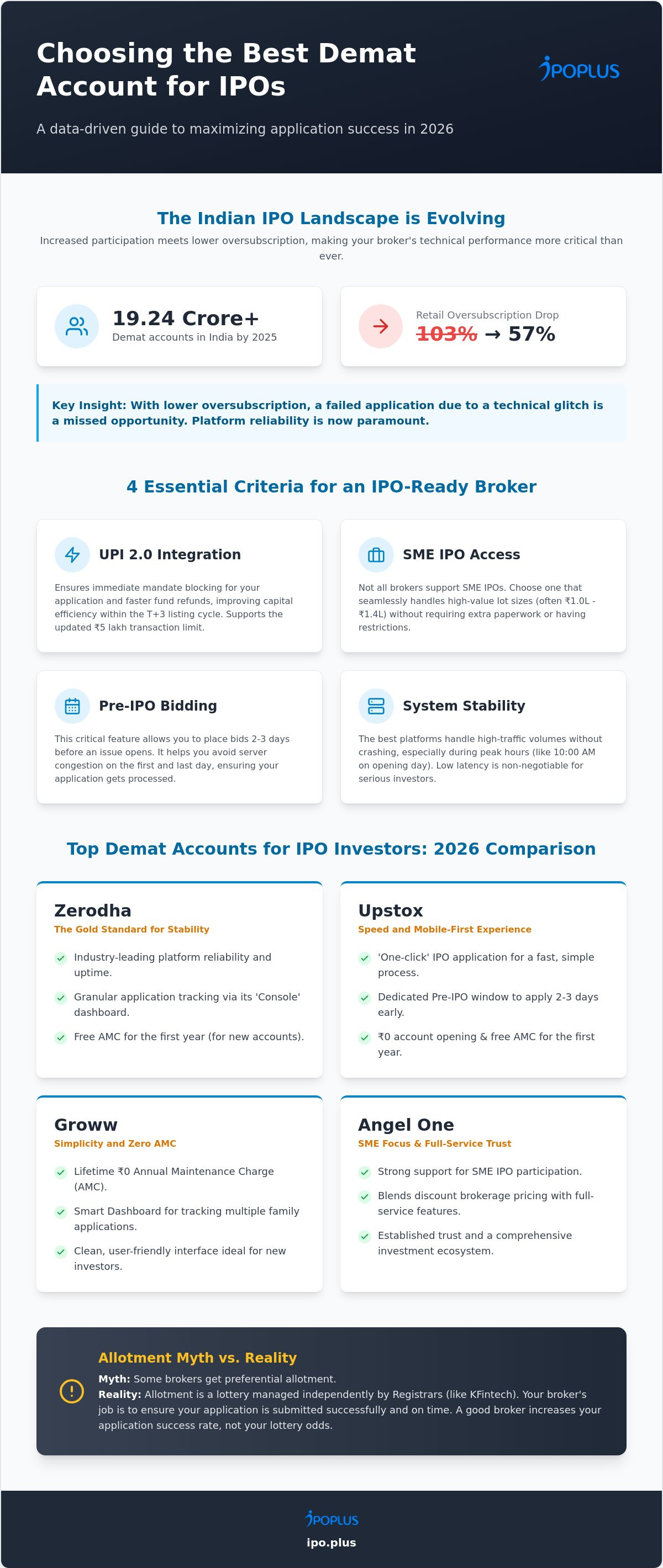
India's demat account base surged past 19.24 crore by 2025, yet retail oversubscription rates dropped from 103% to 57%. This shift means your choice of platform now directly impacts your allotment probability. You've likely dealt with the frustration of a delayed UPI mandate or a broker that lacks SME IPO support during a critical window. Technical glitches shouldn't stand between you and a promising listing. Finding the best demat account for ipo requires a focus on execution speed and system stability rather than just low fees.
We understand that reliable access to the primary market is your priority. This guide identifies the top brokers for 2026 by evaluating UPI mandate triggers, pre-IPO bidding tools, and SME segment compatibility. You'll get a clear comparison of Zerodha, Upstox, Groww, and Angel One. We analyze these platforms against SEBI's T+3 listing timeline and the updated ₹5 lakh UPI transaction limit. This data-first review ensures you select a utility that handles high-traffic volumes without failing at the final step.
Key Takeaways
- Technical reliability is paramount. Evaluate platforms based on UPI 2.0 integration for immediate mandate blocking and faster refund cycles.
- Compare leading providers to find the best demat account for ipo based on SME support and pre-application bidding windows.
- Allotment odds remain uniform across brokers. Registrars like KFintech manage the lottery process independently of your chosen platform.
- Navigate the SME IPO segment effectively. Understand the specific requirements for handling lot sizes ranging from ₹1.0L to ₹1.4L.
- Optimize your strategy using the IPO Plus comparison tool. Complete e-KYC via Aadhaar for instant account activation and market entry.
Key Criteria for Choosing the Best Demat Account for IPOs
Selecting the best demat account for ipo participation requires evaluating technical infrastructure over marketing claims. Investors need a platform that bridges the gap between the stock exchange and their bank account with zero latency. Before diving into specific brokers, understanding What is a Demat Account? provides the necessary context for how shares are electronically held and transferred. In 2026, the criteria have shifted from simple account opening to execution reliability during heavily oversubscribed issues.
Technical stability defines the user experience. UPI 2.0 integration is the primary requirement. This protocol enables immediate mandate blocking and significantly faster refund processing. Capital efficiency is improved when funds are unblocked within 24 hours of the basis of allotment. SME segment access is another vital factor. Many retail apps restrict SME bids due to high-value lot sizes, which often exceed ₹1 Lakh. A reliable broker ensures these lots are accessible without additional paperwork. Interface stability remains the final hurdle. High-traffic windows at 10:00 AM on opening day often crash under-optimized apps. Low latency is non-negotiable for serious investors.
UPI vs. ASBA: Which Application Method Wins?
UPI is the standard for retail investors, supporting applications up to ₹5 Lakh. It offers a mobile-first experience that integrates directly with banking apps. ASBA (Application Supported by Blocked Amount) remains the preferred route for HNI and large SME applications via net banking. Modern brokers now offer automated mandate status tracking. This feature provides real-time updates on whether your bank has successfully blocked the funds. It eliminates the guesswork associated with "pending" statuses that often lead to application rejection. For those using the best demat account for ipo, the system should ideally bridge both methods to provide maximum flexibility.
The Importance of Pre-IPO Bidding Features
Pre-IPO bidding allows you to place orders 2-3 days before the official issue opens. This feature is a critical differentiator for active investors. It helps avoid the server congestion typically seen on the final day of an issue. Top brokers in 2026 provide valid pre-issue windows, collecting bids and pushing them to the exchange the moment it opens. This ensures your application is among the first processed. You must verify the bid placement through exchange-generated SMS or email once the window is live. This step confirms your bid is registered in the exchange system and ready for the lottery process.
Top 5 Demat Accounts for IPO Investors in 2026
Identifying the best demat account for ipo participation requires comparing technical execution rather than just brokerage fees. As of July 2026, five brokers dominate the retail segment based on mandate success rates and SME accessibility. These platforms have optimized their infrastructure to handle the massive influx of retail participants, which reached over 19.24 crore demat accounts in 2025. Choosing the right partner ensures your capital isn't locked due to technical errors during the crucial T+3 listing cycle.
Zerodha: The Gold Standard for Stability
Zerodha remains the industry benchmark for reliability. Its proprietary Console dashboard offers granular tracking of application history and allotment status. The platform utilizes UPI 2.0 for faster mandate approval, unblocking funds efficiently under SEBI's IPO Regulations. For accounts opened on or after June 1, 2026, Zerodha offers a free Annual Maintenance Charge (AMC) for the first year. Investors monitoring Grey Market Premium (GMP) can use a specialized IPO tracking app India to time their bids effectively against market sentiment.
Upstox and Groww: Speed and Simplicity
Upstox and Groww prioritize the mobile-first experience. Upstox features a 'one-click' application process and a dedicated pre-IPO window. This allows you to submit bids 2-3 days before the official issue opening, bypassing Day 1 server congestion. Upstox charges ₹0 for account opening and waives the ₹300 AMC for the first year. Groww maintains a competitive edge with a lifetime ₹0 AMC policy. Its Smart Dashboard is designed for tracking multiple family applications from a single interface. This is a critical feature for retail investors looking to maximize allotment probability across different PAN cards.
Angel One and HDFC Sky: SME and Trust
Angel One provides a full-service experience with discount pricing. It's particularly strong in the SME IPO segment, offering seamless handling of the larger lot sizes (often ₹1 Lakh+) typical of these offerings. The platform waives the ₹240 AMC for the first year. HDFC Sky offers the security of a bank-backed institution combined with a modern discount brokerage interface. It's ideal for investors who prioritize the trust of HDFC Bank while demanding the speed of a digital-native app. Both platforms ensure that mandate requests are pushed to banking apps with minimal delay, reducing the risk of missing the bid deadline.
Selecting a broker is the first step in a disciplined investment strategy. You can use a Stock Broker Comparison Tool to evaluate these platforms side-by-side based on real-time user feedback and technical performance metrics. This ensures your chosen utility matches your specific trading volume and segment interest.
Discount vs. Full-Service Brokers: Allotment Myths
A common misconception among retail investors is that certain brokers hold a "lucky quota" for IPO allotments. This is technically impossible. The lottery process is entirely independent of your brokerage platform. Whether you use a discount broker or a full-service institution, your application enters the same pool. The best demat account for ipo participation is the one that successfully delivers your bid to the exchange without technical failure. Execution reliability is the only variable a broker controls.
The allotment process follows a strictly regulated mathematical model. It ensures that every valid retail application has an equal chance during oversubscription. In 2026, zero brokerage for IPO applications is the industry standard. No broker, discount or full-service, charges fees for the application itself. Costs only arise when you sell the allotted shares in the secondary market. Understanding this distinction helps investors focus on platform stability rather than chasing perceived allotment advantages.
The Registrar's Role in Allotment
Registrars like Link Intime and KFintech are the final authorities in the IPO lifecycle. Your broker collects your bid and transmits it to the exchange (NSE or BSE). The exchange then passes this data to the Registrar. The Registrar verifies the bid against your PAN and DP ID to eliminate duplicate applications. They follow SEBI's IPO Guidelines to conduct the lottery and finalize the basis of allotment. Technical errors at the broker level, such as failing to push the bid to the exchange, are the only way a platform negatively impacts your chances. For a detailed breakdown of the submission process, see our guide on how to apply for ipo.
HNI and Corporate Applications
Full-service brokers still hold an edge for High Net-worth Individual (HNI) and corporate applications exceeding ₹2 Lakh. These entities often utilize 3-in-1 accounts that link banking, demat, and trading functions. This integration allows for seamless fund blocking via ASBA (Application Supported by Blocked Amount) without the need for external UPI mandates. Large-scale investors in the NII (Non-Institutional Investor) category benefit from priority support and dedicated relationship managers. These features are critical when managing complex bids or high-value SME IPO lots. While the best demat account for ipo for a retail user might be a discount app, HNIs often prioritize the institutional-grade reliability of bank-backed brokers for large capital commitments.
Best Platforms for SME IPO Participation
SME IPOs have transitioned from a niche interest to a primary focus for retail investors in 2026. These offerings on the NSE Emerge and BSE SME platforms provide access to high-growth companies before they migrate to the mainboard. However, the technical requirements for these issues differ significantly from standard retail applications. The best demat account for ipo participation in the SME segment must support high-value transactions and provide clear visibility into niche exchange protocols. Investors can monitor these high-ticket opportunities through a dedicated sme ipo list india to ensure they don't miss critical bidding windows.
Capital requirements define the SME experience. While mainboard lots typically cost between ₹14,000 and ₹15,000, SME lot sizes range from ₹1.0L to ₹1.4L. This requires a broker with robust fund-blocking infrastructure. Although the SEBI-mandated UPI limit for IPOs is ₹5 lakh, bank-side success rates for these larger blocks can be inconsistent on smaller apps. Reliable platforms ensure that these high-value mandates are triggered instantly and processed without the latency issues that often plague lower-tier brokers.
SME IPO Application Constraints
Many discount brokers still restrict SME bidding to their web terminals rather than mobile apps. This restriction exists because mobile interfaces often struggle with the specific data fields required for NSE Emerge and BSE SME filings. A linked bank account with strong ASBA (Application Supported by Blocked Amount) support is often more reliable than UPI for these amounts. Fund blocking durations follow the standard T+3 timeline. However, the higher capital commitment means any delay in unblocking funds post-allotment can significantly impact your liquidity for subsequent issues.
Top Rated Brokers for SME Issues
Angel One and ICICI Direct offer the most stable interfaces for SME bidding in 2026. Their systems provide direct integration with the SME exchange segments, reducing the probability of technical mismatches. Rejections in this segment are frequently caused by incorrect DP ID entries or mismatched PAN details. These top-tier brokers utilize pre-filled forms to minimize these manual errors. You should always verify your bid status on the exchange website after applying. This secondary check confirms that your high-value application is active in the system. For a side-by-side technical evaluation of these platforms, access the Stock Broker Comparison Tool to find the utility that best fits your SME investment strategy.
Opening Your Account and Applying: A 2026 Checklist
Establishing a presence in the primary market requires a systematic setup. Finding the best demat account for ipo is only the initial step. Successful participation depends on a five-stage execution checklist to ensure application validity and fund efficiency. The transition to a T+3 listing cycle leaves no room for documentation errors or mandate delays. Follow these steps to prepare your portfolio for upcoming issues.
- Step 1: Evaluate technical reliability using the Stock Broker Comparison Tool. Filter for UPI mandate success rates.
- Step 2: Complete e-KYC. Use an Aadhaar-linked mobile number for instant verification.
- Step 3: Link a mandate-compatible UPI ID. GPay, PhonePe, and BHIM are the most reliable for retail blocks.
- Step 4: Review historical performance data. Analyze the mainboard ipo list 2024 to understand listing gains and sector trends.
- Step 5: Submit your bid. Always select the 'Cut-off Price' to ensure your application remains valid at the final discovered price.
Instant Demat Opening via e-KYC
Digital onboarding has reduced account activation times significantly. In 2026, most accounts are active within 4 to 12 hours of submission. You must have your PAN, Aadhaar, and a digital copy of a 6-month bank statement ready. The statement serves as proof for activating the F&O segment, which is often required for high-value SME bidding. Ensure your name on the PAN card matches your bank records exactly. Even a minor character mismatch can trigger a rejection during the registrar's verification phase. This technical alignment is a critical factor when selecting the best demat account for ipo participation.
Preparing for Your First Application
Setting up your first UPI mandate requires precision. Once you submit a bid, your broker sends a request to your UPI app. You must approve this mandate to block the application amount. Funds don't leave your account; they're simply held until the allotment date. Understanding the 'Cut-off Price' is equally vital. Retail investors should bid at the highest end of the price band to maximize allotment odds. If the final price is lower, the excess amount is unblocked automatically. Before hitting the submit button, verify your DP ID and category selection. Most rejections occur due to incorrect category tagging or insufficient balance in the linked bank account. Use the IPO Tracking Dashboard to monitor your application status in real-time across multiple exchanges.
Optimize Your 2026 IPO Strategy
Execution reliability is the primary differentiator in a market exceeding 19.24 crore demat accounts. Successful participation depends on a broker's technical uptime during high-volume windows and seamless SME segment integration. While allotment remains a registrar-led lottery, your platform choice prevents technical rejections. Identifying the best demat account for ipo requires balancing account maintenance costs with the speed of UPI mandate generation. Zerodha, Upstox, and Angel One lead the 2026 market by prioritizing these execution metrics.
Access data-driven insights to refine your selection process. Our expert analysts provide comprehensive broker reviews based on real-time execution speed and interface stability. Track real-time GMP movements and live subscription status for all active mainboard and SME issues. These variables ensure your capital is deployed effectively within the T+3 listing framework. Compare the latest stock brokers and open your Demat account today to secure your position in the next market offering. Efficient preparation is the only way to navigate the competitive Indian primary market.
Frequently Asked Questions
Which Demat account is best for IPO allotment in 2026?
Allotment probability is identical across all brokers because the registrar manages the lottery process independently. However, the best demat account for ipo participation is one that ensures zero technical failures during the bid push. Zerodha and Upstox are currently the most reliable due to their direct exchange connectivity and stable UPI 2.0 bridges. These platforms minimize the risk of pending mandates that lead to application rejections during heavily oversubscribed issues.
Can I apply for an IPO through multiple Demat accounts?
You cannot apply for the same IPO using multiple demat accounts linked to a single PAN. SEBI's system detects duplicate PAN entries and rejects all associated applications automatically. To increase your allotment chances, it's better to apply using separate demat accounts for different family members. Each application must be linked to a unique PAN and a distinct bank account to remain valid during the registrar's verification phase.
Is a Demat account mandatory for applying for an IPO in India?
Yes, a demat account is mandatory for all IPO applications in India. SEBI regulations require that shares be issued and held only in dematerialized form. While you can place a bid, the shares cannot be credited to you without a valid DP ID and Client ID. It's essential to ensure your demat account is active and e-KYC is completed before the issue's closing date to avoid allotment failures.
Do brokers charge any fees for IPO applications?
No, brokers don't charge any fees for processing IPO applications. This is a primary market transaction where the company issues shares directly to investors. Zero brokerage for IPOs is the standard across both discount and full-service brokers in 2026. You'll only incur costs, such as STT and brokerage, when you decide to sell your allotted shares in the secondary market after the listing date.
Which broker allows the fastest UPI mandate for IPOs?
Zerodha and Upstox currently offer the fastest UPI mandate triggers for retail investors. These brokers have optimized their backend to push bid data to the exchange and banking servers instantly. Finding the best demat account for ipo execution often comes down to this specific speed. Faster triggers reduce the time your application stays in a pending state, ensuring the mandate reaches your banking app well before the daily deadline.
Can I apply for an SME IPO through Zerodha or Groww?
Yes, you can apply for SME IPOs through Zerodha and Groww, though the process may differ from mainboard issues. SME applications require higher capital, typically between ₹1.0L and ₹1.4L per lot. Zerodha allows these applications via its Kite platform using UPI or ASBA. Groww has also streamlined its interface to handle these larger lot sizes. Always check the specific mandate limits of your linked bank before applying for high-value SME lots.
What happens to my money if I don't get an IPO allotment?
Your money remains in your bank account if you don't receive an allotment. The funds are merely blocked via the UPI mandate or ASBA process and are never actually debited. Once the registrar finalizes the basis of allotment, they send an instruction to the banks to release the hold. This unblocking usually happens within 24 hours of the allotment date under the current T+3 listing framework enabled by SEBI.
Is it better to apply for an IPO on Day 1 or Day 3?
Timing doesn't affect your allotment odds since the lottery is random. However, applying on Day 1 is safer to avoid last-minute technical glitches or server congestion. Many investors prefer Day 3 to analyze the Qualified Institutional Buyer (QIB) and Non-Institutional Investor (NII) subscription figures before committing capital. If you choose Day 3, ensure you complete the UPI mandate approval before 5:00 PM to avoid application rejection.