
SME IPO List India 2026: Complete Guide to Small Business Listings
By IPO Plus
Get the complete SME IPO list India for 2026. Our guide helps you analyze risk, track GMP, and navigate the cooling market for high-conviction investments.

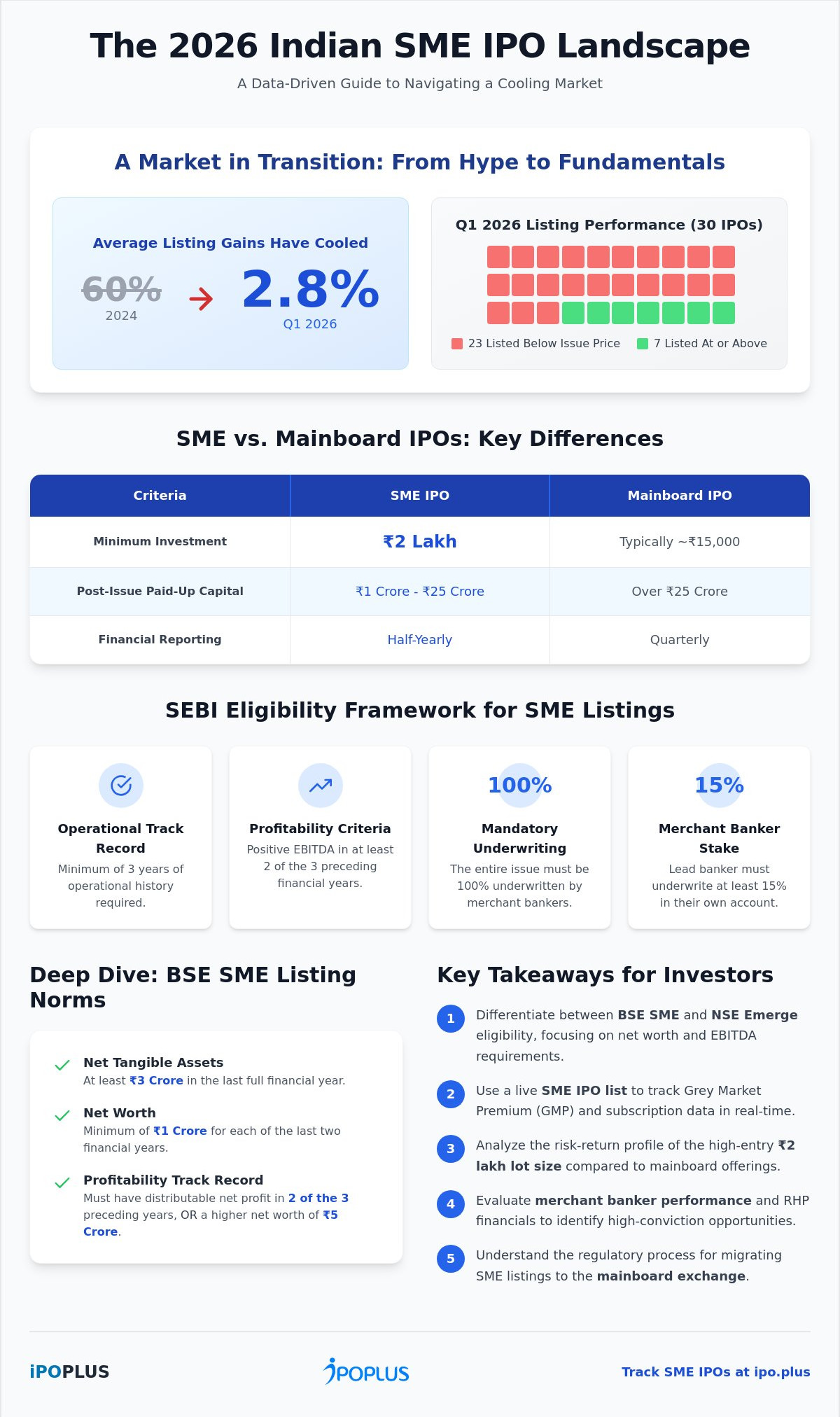
Of the 30 companies that went public between January and March 2026, 23 listed below their issue price. Average listing gains for the sme ipo list india have dropped to 2.8%, a sharp contrast to the 60% recorded in 2024. This data confirms a cooling market where fundamental quality now outweighs speculative momentum.
You're likely managing the impact of the ₹2 lakh minimum investment threshold. High entry costs and low liquidity post-listing create significant barriers for retail participants. Information asymmetry remains a challenge, making it hard to find reliable data on small-cap issuers.
This guide provides a functional breakdown of the SME landscape to improve your decision-making. You'll gain clarity on the distinct requirements for BSE SME and NSE Emerge platforms. We'll show you how to analyze an SME prospectus and track upcoming issues in real-time. Expect a data-first look at risk metrics, market making mandates, and the path to mainboard migration.
Key Takeaways
- Differentiate between BSE SME and NSE Emerge eligibility, focusing on specific net worth and EBITDA requirements for 2026.
- Access a live sme ipo list india to track Grey Market Premium (GMP) and subscription data in real-time.
- Analyze the risk-return profile of the ₹2 lakh entry lot compared to traditional mainboard offerings.
- Evaluate merchant banker performance and RHP financial data to identify high-conviction investment opportunities.
- Master the regulatory process for migrating small-cap listings to the mainboard exchange after the mandatory three-year period.
What is an SME IPO in India? Defining the 2026 Landscape
SME IPOs are public offerings specifically designed for Small and Medium Enterprises to raise equity capital. These issues don't list on the mainboard of the BSE or NSE. Instead, they utilize dedicated platforms with regulatory requirements tailored for smaller capital bases. The sme ipo list india for 2026 reflects a market that has transitioned from a speculative frenzy to a more disciplined environment. This shift follows record-breaking activity in 2025, where 245 companies raised over ₹12,000 crore.
The role of these specialized exchanges is to bridge the funding gap for high-growth startups and localized industries. Traditional bank debt often comes with high interest rates and collateral requirements. Public equity provides a more sustainable path for scaling operations. In early 2026, the market showed signs of moderation. Data indicates that 33 SME companies raised ₹1,476.76 crore through February 2026. This cooling period is helping investors focus on business fundamentals rather than chasing listing day gains.
SEBI Framework for Small Enterprise Listings
SEBI maintains a distinct regulatory framework to balance market access with investor protection. The most critical metric is post-issue paid-up capital. For an SME IPO, this figure must be between ₹1 crore and ₹25 crore. If a company's capital exceeds ₹25 crore, it must list on the mainboard. Reporting standards are also simplified. SME companies provide audited financial results on a half-yearly basis, whereas mainboard firms must report quarterly.
Eligibility in 2026 requires a proven operational track record of at least three years. Companies must demonstrate a positive operating profit (EBITDA) in at least two of the three preceding financial years. Additionally, 100% of the issue must be underwritten. The merchant banker responsible for the issue must underwrite at least 15% from their own account. This ensures that the intermediaries have skin in the game.
The Evolution of SME Market Participation
Investor demographics for the sme ipo list india have changed significantly. Participation was once restricted to High Net-worth Individuals (HNIs) and institutional players. Today, retail interest is surging despite the higher entry barriers. SEBI increased the minimum application size to ₹2 lakh in 2025 to ensure that only informed investors with higher risk appetites participate. This change hasn't dampened enthusiasm; it has merely refined the investor pool.
Digital platforms have revolutionized how investors discover and analyze these issues. The NSE Emerge platform and its BSE counterpart are now more transparent than ever. Retail participants use the Best IPO Tracking App India 2026 to monitor Grey Market Premiums (GMP) and subscription levels in real-time. This access to data has reduced the information asymmetry that previously plagued the small-cap segment. Investors now move beyond company names to scrutinize cash flow statements and merchant banker track records before committing capital.
Understanding the SME Platforms: BSE SME vs NSE Emerge
India's SME ecosystem operates through two distinct exchange verticals. The BSE SME platform and NSE Emerge provide the core infrastructure for these listings. Every entry on the sme ipo list india is categorized under one of these two exchanges. Selecting a platform isn't just administrative; it dictates secondary market liquidity and institutional visibility. While both follow SEBI's broad guidelines, their specific eligibility norms and sector preferences differ significantly.
Liquidity remains the primary concern for participants in this segment. SME stocks don't trade in single units. They trade in pre-defined lot sizes. This structure makes the role of the exchange's market makers vital. Investors should verify which platform a company chooses, as this often reflects the business's scale and its long-term migration plans. In FY2026, the 111 SME IPOs that raised ₹5,363 crore were split between these two venues based on their financial health and growth stage.
BSE SME: Features and Listing Norms
BSE maintains a dominant historical presence in the small-cap segment. It typically attracts traditional industries like manufacturing, textiles, and chemicals. The listing criteria are rigorous but clear. A company needs net tangible assets of at least ₹3 crore in the last full financial year. The net worth must be a minimum of ₹1 crore for each of the last two financial years. BSE requires either a distributable net profit for two of the three preceding years or a higher net worth threshold of ₹5 crore. This platform is often the first choice for established family-run businesses looking for structured capital.
NSE Emerge: The Growth-Oriented Platform
NSE Emerge positions itself as the preferred hub for tech-enabled and innovative startups. It emphasizes operational efficiency over historical asset size. The platform requires an EBITDA of at least ₹1 crore in two of the preceding three financial years. Net tangible assets must also meet the ₹3 crore mark. NSE Emerge is known for hosting businesses in the SaaS, renewable energy, and fintech sectors. To combat liquidity issues, the exchange mandates compulsory market making for three years post-listing. This ensures there's always a buy and sell quote available for the large lot sizes typical of the SME segment.
Consolidating data from both exchanges is essential for a complete market view. You can track active issues and upcoming dates across both platforms using the IPO Tracking Dashboard for real-time updates. Monitoring the sme ipo list india through a centralized tool helps identify sector-specific trends that might be missed when looking at exchanges in isolation. Whether a company lists on BSE or NSE, the fundamental requirement for 100% underwriting remains the same, providing a baseline level of security for the issue's success.
SME IPOs vs. Mainboard IPOs: Evaluating Risk and Reward
Mainboard IPOs target mass retail participation with entry points typically around ₹15,000. SME issues operate under a different capital structure. The sme ipo list india features companies with a significantly higher entry barrier. Following regulatory shifts in 2025, the minimum application size for an SME IPO is now ₹2 lakh. This represents a 13x increase compared to mainboard issues. This high threshold intentionally limits the segment to investors with larger capital bases and higher risk tolerance.
Volatility is a defining characteristic of this segment. Mainboard stocks generally have stable price discovery due to high institutional volumes. SME stocks often experience massive percentage swings on relatively low volume. In early 2026, the average listing gain for SMEs dropped to 2.8%, with 23 out of 30 companies listing below their issue price. Transparency levels also differ. While mainboard firms file quarterly results, companies on the BSE SME platform only disclose audited financials half-yearly. This less frequent reporting creates longer information gaps for the public.
Investment Minimums and Lot Sizes
The ₹2 lakh minimum isn't restricted to the initial application. It dictates the entire trading lifecycle. Shares are bundled into fixed lots. If a lot size is 1,600 shares, you must buy or sell the entire bundle. You can't liquidate five shares to cover a small expense. This structure ensures that the sme ipo list india remains a high-conviction market. These high entry barriers lead to lower subscription totals compared to the millions of applications seen in mainboard mega-issues. It also means that a single bad trade can impact a retail portfolio more severely.
Liquidity and Market Making Requirements
Illiquidity is the primary concern for SME investors. SEBI mitigates this risk through mandatory market making. Every SME IPO requires a designated market maker for three years post-listing. These entities provide two-way quotes for at least 75% of the trading time. This ensures that a seller can find a buyer even if there's no natural market interest at that moment.
Trading frequency remains lower than the mainboard. Stocks on the mainboard trade every second. SME stocks might see only a few trades per hour. The regulatory framework also mandates that 100% of the issue must be underwritten. Merchant bankers hold at least 15% of this underwriting on their own books. This mandate prevents issue failure but doesn't guarantee a profitable exit. Investors must also account for the Offer for Sale (OFS) cap, which is limited to 20% of the total issue size for SMEs in 2026.
Decoding the SME IPO List: Metrics That Matter for Allotment
Successful participation in the sme ipo list india requires looking past the brand name. The Red Herring Prospectus (RHP) provides the raw data needed for objective valuation. One critical area is the "Objects of the Issue." Investors must distinguish between companies raising capital for expansion and those using funds primarily for debt repayment. Growth-oriented capital is often a signal of long-term scalability. If more than 30% of the proceeds are allocated to "General Corporate Purposes," it may indicate a lack of clear strategic direction.
Financial health is the next layer. Scrutinize the operating cash flow over the last three fiscal years. A company reporting profit on paper but negative cash flow from operations is a major red flag. In the 2026 market, where listing gains have moderated, these fundamentals dictate whether a stock holds its value after the initial hype. You can analyze these financial trends across the entire sme ipo list india using the IPO Tracking Dashboard to ensure you're only bidding on high-conviction issues.
The Merchant Banker Track Record
Lead managers act as the primary filter for SME exchanges. Unlike mainboard issues, where multiple banks share responsibility, a single merchant banker often handles the entire SME process. Their reputation is a vital signal. Some lead managers are known for bringing high-quality, fairly priced businesses to market. Others may have a history of issues that list at a premium but crash shortly after. To verify a lead manager's quality, examine the percentage of their past issues currently trading above the original offer price. Quality merchant bankers also tend to underwrite a larger portion of the issue than the mandatory 15% minimum, demonstrating confidence in the company's valuation.
Subscription Status and GMP Signals
Subscription levels reflect institutional and HNI confidence in real-time. In the SME segment, retail interest is often high, but the "Non-Institutional Investor" (NII) category is the one to watch. Large-scale oversubscription in the NII category often correlates with listing day performance. However, high subscription doesn't eliminate risk. It merely indicates high demand for the limited number of lots available.
Grey Market Premium (GMP) serves as an unofficial sentiment indicator. It represents the price at which IPO shares are traded in an unregulated market before listing. While a high GMP suggests a positive debut, it's highly volatile. Relying solely on GMP is dangerous. In early 2026, several issues with strong grey market numbers listed at a discount due to sudden shifts in secondary market liquidity. GMP should only be used to gauge market heat, never as a replacement for fundamental RHP analysis.
Tracking the 2026 SME IPO Pipeline with IPO Plus
Monitoring the sme ipo list india requires a centralized data hub. Static tables often fail to reflect rapid changes in Grey Market Premiums (GMP) or subscription figures. The IPO Tracking Dashboard provides a modular view of the 2026 pipeline. It aggregates data from both BSE SME and NSE Emerge. This allows for direct comparison of issues based on sector, issue size, and current market sentiment.
Users can filter the 2026 list to identify specific opportunities. If you focus on tech-enabled startups on NSE Emerge, the dashboard isolates those entries. It removes the noise of unrelated sectors. This functional approach ensures that investors spend more time on analysis and less on data collection. The system updates status markers from "Upcoming" to "Active" and "Listed" automatically. This chronological tracking is essential for managing the tight subscription windows common in the SME segment.
Real-Time SME Dashboard Features
The dashboard integrates several high-utility tools for the SME segment:
- Live Subscription Tracking: Monitor real-time bids across HNI and retail categories to gauge demand.
- One-Click Allotment: Check your allotment status through direct links to registrar databases.
- Financial Calculators: Estimate potential listing gains or losses based on current GMP and lot sizes.
- Merchant Banker Analytics: Access historical performance data of lead managers associated with active issues.
You can verify a lead manager's credibility by reviewing the listing-day gains of their previous five SME issues on the platform. These features address the information asymmetry common in small-cap listings. By centralizing these variables, the platform provides a transparent view of market movements.
Setting Up SME IPO Alerts
Speed is essential when managing the ₹2 lakh minimum investment required for SMEs. The IPO Plus Android App delivers push notifications for critical events. You receive alerts for new DRHP filings, price band announcements, and final allotment timings. This ensures you don't miss the narrow three-day subscription window typical of these issues. The mobile interface is optimized for speed, allowing you to track GMP shifts while on the move.
Before hitting the "Apply" button, use the integrated Stock Broker Comparison Tool. It helps evaluate which platforms offer the best interface for high-value SME applications. A final checklist should include:
- Verification of the company's EBITDA track record for the last two years.
- Review of the merchant banker's past listing performance.
- Confirmation of the mandatory 100% underwriting status.
- Assessment of the current Grey Market Premium against broader market trends.
Transitioning from data observation to market participation requires reliable tools. The sme ipo list india is volatile; having real-time alerts minimizes the risk of missing entry or exit points. Use the app to maintain a disciplined approach to the 2026 small-business listing cycle.
Scaling Your SME Investment Strategy for 2026
The 2026 market requires a transition from momentum chasing to disciplined, data-driven selection. Success depends on scrutinizing the ₹2 lakh minimum lot issues and understanding the distinct listing norms of BSE SME and NSE Emerge. Merchant banker track records and operational cash flow metrics serve as the primary indicators of post-listing stability. You've seen how the sme ipo list india has moderated since the 2024 peak, making fundamental quality more critical than ever.
This environment rewards participants who utilize real-time analytics to bypass information asymmetry. Precision in evaluating subscription heat and grey market trends is your best defense against secondary market illiquidity. Access the centralized data needed to navigate these high-conviction issues today.
Track the Latest SME IPOs on the IPO Plus Dashboard for real-time subscription tracking, comprehensive merchant banker data, and direct allotment status links. Strategic participation in the small-cap segment remains a powerful path for informed portfolios. Stay vigilant and trade with clarity.
Frequently Asked Questions
What is the minimum investment for an SME IPO in India?
The minimum investment for an SME IPO is ₹2 lakh per application. This threshold was increased from the previous ₹1 lakh limit in 2025 to ensure higher risk-bearing capacity among participants. This amount applies to a single lot. Investors cannot apply for fractional lots or lower amounts in this segment.
How is SME IPO allotment different from Mainboard IPOs?
SME IPO allotment follows a lot-based lottery system when oversubscribed. Because the minimum application is ₹2 lakh, the total number of retail applicants is significantly lower than mainboard issues. Allotment is finalized by the registrar based on the basis of allotment document. You can track these updates for the sme ipo list india directly via registrar links on our dashboard.
Can retail investors apply for SME IPOs via UPI?
Retail investors can use UPI to apply for SME IPOs if the total application value is ₹5 lakh or less. Since the minimum SME lot starts at ₹2 lakh, UPI is a standard payment method for most retail participants. Applications exceeding the ₹5 lakh limit must use the ASBA facility through a supported bank account.
Why are SME IPO lot sizes so large compared to Mainboard?
Large lot sizes are mandated to ensure that only investors with high risk tolerance participate in the small-cap segment. These lots also help manage liquidity in the secondary market. By keeping trades in large blocks, the exchange reduces the impact of high-frequency retail churn on small-cap stocks. Trading remains restricted to these lot sizes post-listing.
Is it safe to invest in an SME IPO based on the Grey Market Premium (GMP)?
Investing solely based on Grey Market Premium (GMP) is not safe. GMP is an unregulated sentiment indicator and doesn't guarantee listing performance. In early 2026, 23 out of 30 companies listed below their issue price despite positive grey market signals. Always prioritize fundamental analysis of the Red Herring Prospectus over unregulated market trends.
How can I check the SME IPO allotment status on IPO Plus?
You can check allotment status by visiting the IPO Plus dashboard or using the Android app. The platform provides direct links to official registrar sites. Enter your PAN or application number on the registrar's portal via our interface to view results. This centralized access saves time during the high-traffic allotment period.
What happens to SME shares after the 3-year market making period?
The compulsory market making period ends after three years. The company may then continue with voluntary market making or apply for migration to the mainboard exchange. Migration requires meeting specific mainboard listing criteria and obtaining shareholder approval. If the company remains on the SME platform, liquidity may decrease without a designated market maker providing quotes.
Can I sell SME IPO shares in the open market like regular stocks?
You can sell SME shares in the open market, but they must be traded in the original lot sizes. Unlike mainboard stocks, you cannot sell a single share. If your lot size is 1,200 shares, your sell order must be for 1,200 shares or multiples thereof. This requirement persists until the company successfully migrates to the mainboard exchange.