
How to Apply for IPO in India: A Complete 2026 Step-by-Step Guide
By IPO Plus
Learn how to apply for ipo in India with our 2026 guide. Avoid errors, understand UPI vs. ASBA, and track your T+3 allotment with this step-by-step process.

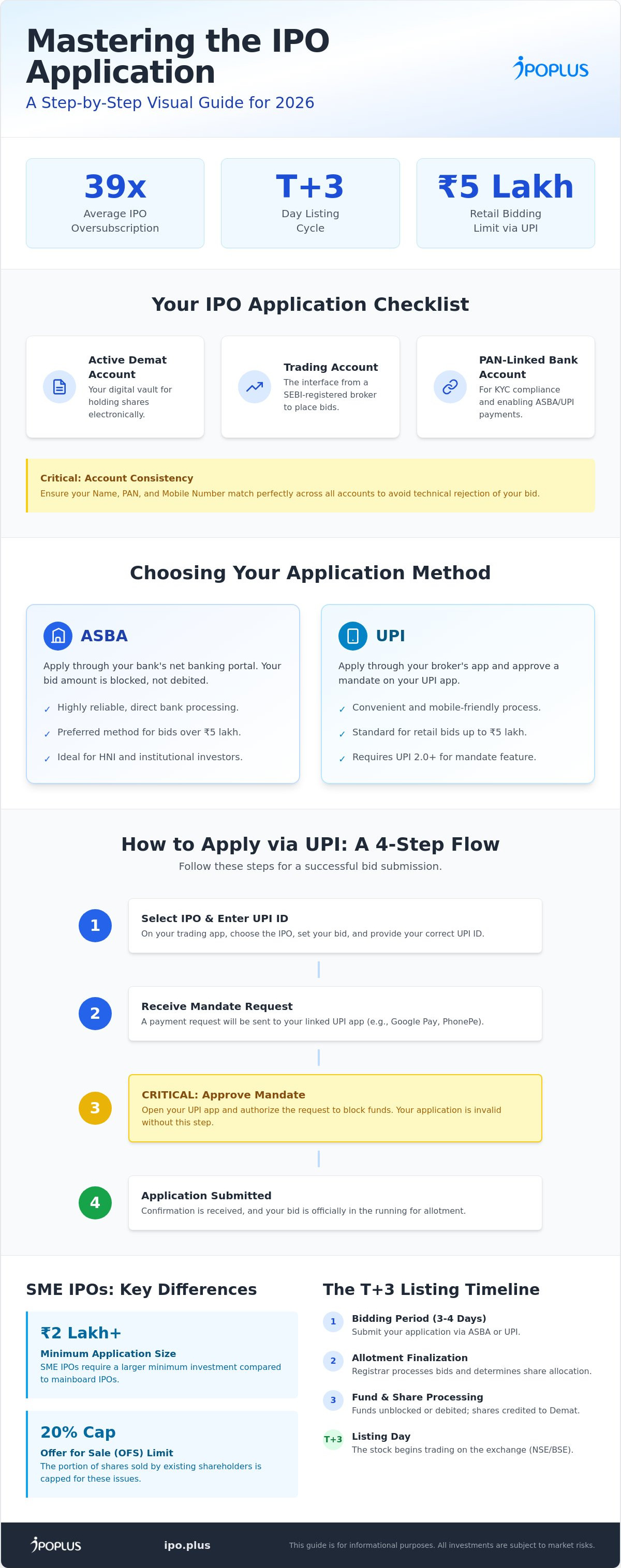
In the fiscal year 2025-26, the average IPO oversubscription reached 39x across 108 mainboard listings. This high competition means a single technical error can disqualify your bid before the lottery begins. If you're unsure how to apply for ipo without risking blocked funds or missed deadlines, you aren't alone. Most retail investors find the choice between UPI and ASBA confusing, especially with the current T+3 listing cycle requirements.
We understand the anxiety of seeing your capital locked while waiting for allotment results. This guide provides a functional, step-by-step framework to master the application process in 2026. You'll learn to navigate the ₹5 lakh UPI limit, execute error-free mandates, and track your status with precision. We'll break down the transition from fund blocking to final listing so you can participate in the market with total clarity and confidence.
Key Takeaways
- Confirm mandatory prerequisites including a PAN-linked bank account and an active Demat account for electronic share storage.
- Compare ASBA and UPI payment methods to manage the ₹5 lakh retail bidding limit and fund blocking protocols.
- Follow a data-driven framework on how to apply for ipo to ensure correct lot selection and successful mandate execution.
- Understand SME IPO specifics, including the ₹2 lakh minimum application size and the 20% Offer for Sale (OFS) cap.
- Monitor the T+3 listing timeline to track allotment status and ensure timely fund refunds or share credits.
Essential Prerequisites for IPO Application in India
An IPO is the primary mechanism for a private corporation to raise capital by issuing shares to the general public. Understanding What is an Initial Public Offering (IPO)? is vital for any retail investor looking to enter the equity market at the ground level. In India, the Securities and Exchange Board of India (SEBI) regulates this process to ensure transparency. Before you learn the technical steps of how to apply for ipo, you must establish a specific financial infrastructure. This setup ensures your bid is valid and your funds are handled securely through the banking system.
The first requirement is an active Demat account. This account acts as a digital vault for your securities. Shares in India are no longer issued in physical certificates; they're held in electronic form by depositories like NSDL or CDSL. Alongside this, you need a trading account provided by a SEBI-registered broker. While the trading account is used for buying and selling on the secondary market, it serves as the interface for your primary market IPO bids. Your Permanent Account Number (PAN) is the central link. It identifies you for tax purposes and KYC compliance. If your PAN isn't correctly mapped to your bank and Demat accounts, the registrar will likely reject your application during the technical scrutiny phase.
Mandatory Account Linking
Technical consistency across your accounts is the most common point of failure for retail bidders. You must ensure your PAN is updated with your Depository Participant (DP). Any mismatch in the name or ID will trigger a rejection. Verify that your bank account supports the Unified Payments Interface (UPI) 2.0 or Application Supported by Blocked Amount (ASBA). Your mobile number must be linked to your bank account to receive the mandatory OTPs and mandate alerts. If you don't receive and approve the UPI mandate, your application remains "Pending" and won't be considered for allotment.
The IPO Lifecycle Timeline
The Indian IPO process follows a strict chronological sequence. The bidding period is the window where you submit your application, usually spanning 3 to 4 working days. Once this window closes, the registrar begins the allotment process. They compare the total bids against the available shares. As of 2026, the listing timeline is compressed to T+3 working days. This means the stock begins trading on the NSE and BSE within three days of the issue's closure. Knowing how to apply for ipo involves tracking these specific dates to manage your liquidity, as funds remain blocked until the allotment is finalized.
Choosing an Application Method: ASBA vs. UPI
Retail investors in India have two primary channels for bidding: Application Supported by Blocked Amount (ASBA) and the Unified Payments Interface (UPI). Both methods comply with SEBI's regulatory guidelines to ensure investor protection. The core mechanic is identical; your funds aren't debited immediately. Instead, the bank marks a lien on the specific bid amount. This money remains in your savings account, earning interest, until the allotment is finalized. If you aren't allotted shares, the block is lifted. If you are successful, the exact amount is debited, and shares are credited to your Demat account.
Selecting the right method depends on your bid value and technical preference. UPI is the standard for retail applications up to ₹5 lakh. It offers high mobility and integrates directly with most stockbroking apps. ASBA remains the preferred route for High Net-worth Individuals (HNIs) bidding above ₹5 lakh or those who prefer the security of their bank's direct portal. To stay updated on which issues are currently open for bidding, you can use an IPO Tracking Dashboard for real-time status updates.
ASBA via Net Banking
ASBA is a bank-centric process. You don't need a broker's interface to submit your bid. Log in to your bank’s net banking portal and locate the "Investment" or "IPO" tab. The system displays a list of active issues. Select the desired IPO and input your DP ID, which consists of your Depository (NSDL/CDSL) and your client ID. Enter your bid details, including the lot size and price. Most retail investors choose the "Cut-off price" to maximize allotment chances. Once submitted, the bank blocks the funds instantly. This method is highly reliable as it bypasses third-party payment gateways.
UPI-Based Applications
UPI has simplified how to apply for ipo for millions of smartphone users. The process starts on your broker's platform. After selecting the IPO, you enter your UPI ID (e.g., name@bank). The broker sends a request to your UPI app, such as BHIM, Google Pay, or PhonePe. You must log in to that app to approve the "Mandate Request." This approval is the critical step that blocks the funds in your bank account. Ensure your UPI app is updated to support UPI 2.0, as older versions may fail to process mandate blocks. Failure to approve the mandate before the bidding window closes results in an automatic bid rejection.
Step-by-Step Guide to Applying via UPI
The Unified Payments Interface (UPI) is the primary bidding channel for most Indian retail investors. It integrates your bank account with your stockbroker's interface through a seamless mandate system. To begin, login to your trading platform or use the best ipo tracking app india 2026 to identify currently open issues. These platforms provide real-time data on price bands and lot sizes. Understanding how to apply for ipo via UPI involves two distinct phases: the bid placement on the broker's terminal and the mandate authorization on your mobile device. Efficiency in both steps is required to ensure your application reaches the registrar before the daily 5:00 PM cutoff.
Once you select an active IPO, the system prompts you for bid details. You must enter your bid quantity in exact multiples of the predefined lot size. For example, if the lot size is 50 shares, you can bid for 50, 100, or 150 shares. Most platforms allow up to three different bid combinations, but only one will be considered for final allotment. After entering your UPI ID, submit the form. The exchange then validates your details and sends a request to your bank's payment gateway. This technical handshake is the foundation of how to apply for ipo in a digitized market.
Placing the Bid
Select the "Retail" category if your total bid value is below ₹2 lakh. This category usually has a reserved portion of the total issue size. Enter the number of lots you wish to purchase; the system automatically calculates the total investment amount based on your price input. Always choose the "Cut-off Price" to remain eligible for allotment regardless of where the final price is discovered. The Cut-off Price is the final discovery price at which shares are issued to successful bidders based on market demand. Choosing this option prevents your bid from being rejected if the final price is higher than a specific limit you might have manually entered.
Managing the UPI Mandate
Submitting the bid is only half the process. You must check the "Mandates" or "Pending Requests" section in your UPI app, such as BHIM or Google Pay. A notification typically arrives within a few minutes, though it can take several hours during high-traffic periods. Verify the merchant name, which is usually the stock exchange or the issue registrar, before inputting your secure PIN. Approving this mandate creates a legal lien on your funds. Keep the mandate active and don't delete the request until the allotment date is reached. If you cancel the mandate or have insufficient funds at the time of approval, your bid is automatically invalidated.
Applying for SME IPOs: Key Differences
SME IPOs represent a distinct asset class with specific regulatory frameworks. These offerings are tailored for smaller companies listing on the BSE SME or NSE Emerge platforms. The entry barrier for retail participants is significantly higher than mainboard issues. Effective April 11, 2026, SEBI increased the minimum application size for SME IPOs to ₹2 lakh. This regulatory shift ensures that only investors with substantial capital and higher risk appetites participate in these volatile segments. SME companies must also demonstrate a positive operating profit (EBITDA) in at least two of the three preceding financial years to qualify for an IPO.
The technical workflow of how to apply for ipo in the SME category mirrors the mainboard process. You use either UPI or ASBA. However, the capital commitment is concentrated. You cannot bid for fractions of a lot. You must block the entire lot value, which often starts at ₹2 lakh per application. This requires precise liquidity management. The Offer for Sale (OFS) component in these issues is strictly capped at 20% of the total issue size. This cap prevents excessive promoter exits and ensures more capital reaches the company for growth.
Lot Sizes and Capital Requirements
Review the mainboard ipo list 2024 to observe how mainboard capital requirements, usually in the ₹15,000 range, contrast sharply with SME norms. Your bank account must maintain the full lot value for the duration of the block. SME bids are rigid. They cannot be fragmented into smaller retail quantities to fit a lower budget. If you apply for an SME IPO, ensure your UPI limit is adjusted, as the standard ₹5 lakh limit applies but the minimum ticket size is much larger. Track these requirements across different issues using our IPO Tracking Dashboard for real-time updates.
SME Subscription Tracking
Investor interest in SMEs is often more concentrated and volatile. Monitor real-time SME subscription data on IPO Plus to gauge institutional and retail demand. Check the Grey Market Premium (GMP) specifically for SME issues to estimate listing sentiment. SME listing gains can be substantial, often exceeding 50% on day one. However, these issues carry higher exit risks due to lower post-listing liquidity. The lot-based trading system on the secondary market means you must sell in entire lots. This can be difficult if trading volumes are low. Understanding how to apply for ipo in this segment requires a focus on both the application mechanics and the eventual exit strategy.
Tracking Your Application and Allotment Status
The lifecycle of an IPO bid doesn't end with the mandate approval. After you've mastered how to apply for ipo and submitted your bid, the application moves through a specific status sequence. It begins as "Submitted" once the broker receives the data. It transitions to "Mandate Approved" after you authorize the block in your UPI app. The final status is either "Allotted" or "Refunded" based on the registrar's lottery outcome. In the current T+3 listing environment, this entire progression is rapid. Funds remain blocked only until the allotment finalization, ensuring capital isn't held longer than necessary.
Subscription data is the most critical variable in determining your allotment probability. In the fiscal year 2025-26, the average total oversubscription for mainboard IPOs was 39x. When an issue is oversubscribed 50x or 100x, the registrar uses a lottery system for the retail category. This means even a perfectly executed application doesn't guarantee shares. If you aren't allotted shares, the bank automatically lifts the lien on your funds. This unblocking usually happens within 24 hours of the allotment date. You don't need to contact your bank; the registrar sends a release instruction to the clearing house directly.
Official allotment status is hosted on registrar portals like Link Intime or KFintech. You'll need your PAN or application number to check your status. These portals are the single source of truth, often updating several hours before you receive an SMS from the exchange. Knowing how to apply for ipo also means knowing where to look when the bidding window closes. If you see "Shares Allotted," the shares will be credited to your Demat account, typically one working day before the listing date.
Using the IPO Plus Dashboard
The IPO Tracking Dashboard simplifies post-application monitoring by aggregating data in one location. You can track live subscription numbers across Retail, HNI, and QIB categories in real-time. This helps you gauge the competition level for active issues. The dashboard also provides Grey Market Premium (GMP) updates, which act as an unofficial indicator of listing day sentiment. You can set alerts for allotment status links and listing day performance to ensure you don't miss critical market movements.
What to Do After Allotment
Successful allotment requires a clear exit or hold strategy. Check your Demat account for share credit the evening before the listing. On listing day, the pre-open session runs from 9:00 AM to 9:45 AM. This is where price discovery happens. Institutional and retail orders are matched to determine the opening price. You must decide whether to sell for listing gains or hold for long-term appreciation. Listing day gains in FY 2025-26 averaged 8%, reflecting a more cautious market compared to previous years. Use the IPO Plus Android App to monitor opening ticks and volume data to execute your trade efficiently.
Master Your Primary Market Strategy
Successful participation in the primary market requires technical precision and data-driven timing. You've established the core requirements for valid bidding, from Demat linking to UPI mandate approval. Understanding the distinction between Mainboard and SME capital barriers protects your liquidity. Mastering how to apply for ipo ensures your capital is deployed efficiently within the compressed T+3 settlement framework. This disciplined approach minimizes the risk of technical rejections during oversubscribed issues.
Tracking fast-moving variables manually increases the risk of missing critical allotment updates or listing day price discovery. Thousands of Indian retail investors rely on centralized data to manage their bidding pipelines. Download the IPO Plus App for Real-Time GMP and Allotment Alerts to access live Mainboard and SME tracking. You'll receive instant updates on subscription levels across all categories and the latest Grey Market Premium (GMP) data.
The 2026 market offers diverse opportunities for those who approach it with methodical organization. Start tracking your next bid today to build a consistent and professional investment workflow.
Frequently Asked Questions
Can I apply for an IPO without a Demat account?
No, you cannot apply for an IPO without an active Demat account. SEBI regulations require all IPO allotments to occur in electronic format. Shares are credited to your Depository Participant (DP) account, which identifies your holdings for the exchange. If you don't have a Demat account, you must open one with a registered broker before initiating the application process to avoid immediate technical rejection.
How much time does it take for funds to be unblocked if I don’t get an allotment?
Funds are typically unblocked within 24 hours of the finalization of the allotment basis. Under the T+3 listing cycle, the registrar sends electronic instructions to banks to release the lien on unsuccessful bids. While most banks process this immediately, some may take up to two working days. You should monitor your bank balance for the removal of the blocked status rather than waiting for a credit transaction.
Is it better to apply for an IPO on the first day or the last day?
Allotment probability remains identical regardless of the application day, as the process is a computerized lottery for oversubscribed issues. However, applying on the final day allows you to review subscription figures across QIB and HNI categories. This data helps you gauge market sentiment and listing potential. Ensure you complete the process before the 5:00 PM cutoff to avoid technical delays in mandate processing.
Can I use someone else’s UPI ID or bank account to apply for an IPO?
No, third-party applications are strictly prohibited and will result in automatic rejection. The Permanent Account Number (PAN) linked to the bank account or UPI ID must match the PAN registered with your Demat account. This rule prevents fraudulent applications and ensures tax compliance. If you use a family member's UPI ID for your bid, the registrar's technical filter will invalidate the application during the scrutiny phase.
What is the maximum limit for a retail investor in an IPO?
The maximum application limit for the Retail Individual Investor (RII) category is ₹2 lakh. If your bid exceeds this amount, you are categorized as a Non-Institutional Investor (NII) or HNI. While the UPI payment limit for IPOs is ₹5 lakh, any bid above ₹2 lakh follows different allotment rules. Understanding these thresholds is essential when learning how to apply for ipo to ensure you select the correct investor category.
Why was my IPO application rejected even though I had funds?
Rejections typically occur due to technical mismatches or incomplete mandates. Common reasons include a PAN mismatch between the bank and Demat accounts, incorrect DP ID entry, or failure to approve the UPI mandate before the deadline. Even with sufficient funds, a bid is invalid if the bank cannot establish a legal lien. Always verify your application status on the registrar's portal to identify the specific reason for a technical rejection.
How do I modify or cancel an IPO bid after submission?
You can modify or cancel your bid through your stockbroker's platform only while the bidding window remains open. Navigate to the Order Book or IPO History section to edit the lot size or price. Once you submit a modification, a new UPI mandate request is sent to your app. You must approve this new mandate to replace the previous one. Cancellations are not permitted after the issue closes.
What happens if I approve the UPI mandate after the IPO closes?
Approving a UPI mandate after the official bidding window closes results in a failed application. The exchange servers stop accepting bid confirmations at the daily 5:00 PM cutoff. Even if your bank blocks the amount later, the data will not reach the registrar for allotment consideration. Ensuring timely approval is a critical part of how to apply for ipo successfully. Funds blocked after the deadline will eventually be released by the bank.