
Live IPO GMP Today: Real-Time Grey Market Premium and Listing Gains 2026
By IPO Plus
Track live ipo gmp today with real-time updates on grey market premium, Kostak rates & listing gains. Make data-driven decisions for Mainboard & SME IPOs.

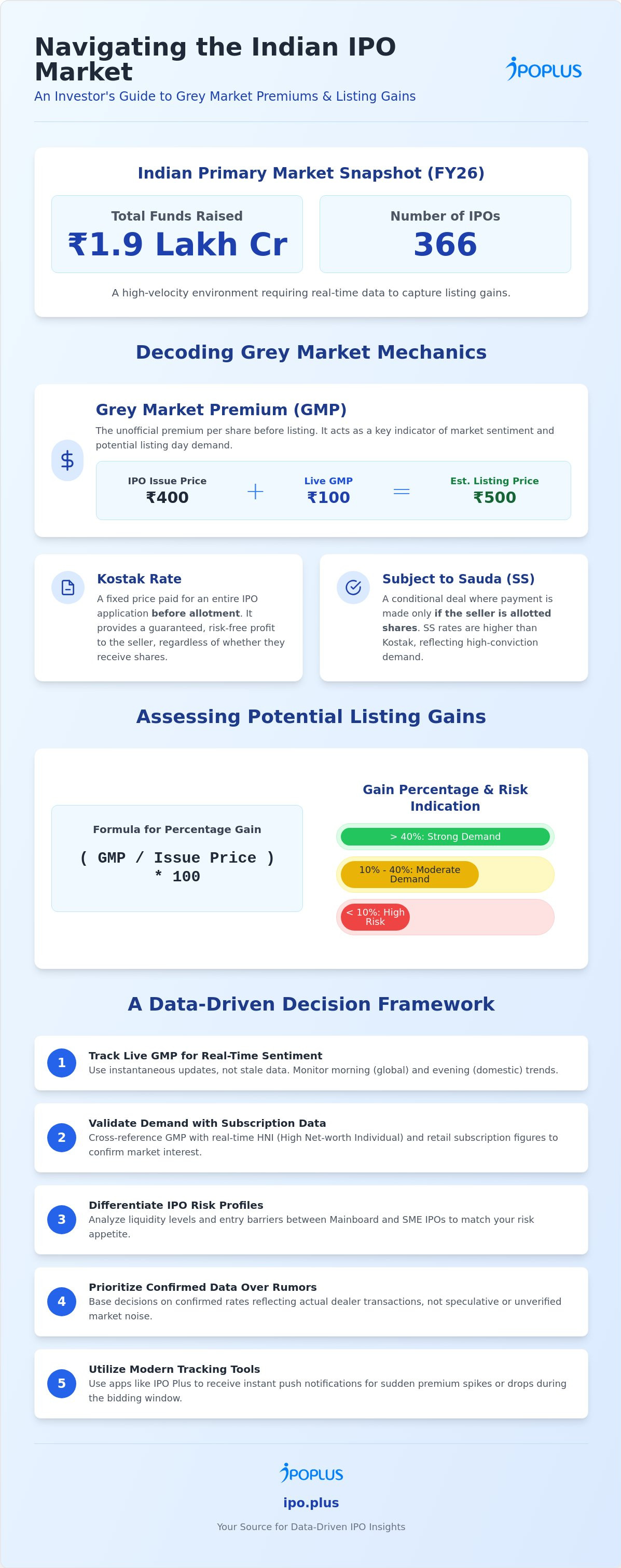
With ₹1.9 lakh crore raised across 366 IPOs in FY26, the Indian primary market moves faster than most tracking tools can handle. Relying on stale data means missing the narrow window for optimal listing gains. Tracking live ipo gmp today is the only way to navigate this high-velocity environment effectively. You know the frustration of finding fragmented data across multiple sites while trying to make a split-second investment decision.
We provide instantaneous updates on current premiums, Kostak rates, and Subject to Sauda figures to ensure your strategy is backed by facts. You'll find real-time accuracy for active issues like Kusumgar, currently at a ₹138 premium, and IC Electricals at ₹42. This article breaks down how to calculate expected listing prices and analyzes whether the current SME IPO landscape, with its new 2026 SEBI lock-in rules, offers a viable risk-to-reward ratio for your portfolio. We move from upcoming alerts to active status updates to keep you informed of every market movement.
Key Takeaways
- Understand the mechanics of GMP, Kostak rates, and Subject to Sauda to effectively hedge against listing day volatility.
- Differentiate between Mainboard and SME IPO risk profiles by analyzing liquidity levels and 2026 lot size entry barriers.
- Validate market demand by cross-referencing live ipo gmp today with real-time HNI and retail subscription data.
- Use the IPO Plus Android App to receive push notifications for sudden premium spikes or drops during the bidding window.
- Implement a multi-factor decision framework that prioritizes data-driven insights over unverified market rumors and fragmented data.
Live IPO GMP Today: Real-Time Market Sentiment and Listing Expectations
Grey Market Premium (GMP) represents the unofficial price at which shares are traded before the official Initial Public Offering (IPO) listing. It functions as a proxy for market sentiment. High demand drives premiums upward. Weak interest or negative global cues cause sharp declines. Monitoring live ipo gmp today provides a real-time snapshot of how institutional and retail participants perceive an issue's value relative to its price band. It's a vital tool for short-term traders seeking listing gains.
The calculation for market expectations is simple. Add the current GMP to the IPO issue price to find the estimated listing price. If an issue is priced at ₹400 and the premium is ₹100, the projected listing price is ₹500. Daily volatility is common. Factors like overnight US market performance, sector-specific news, and broader Nifty movements impact these unofficial rates. Traders use these figures to decide whether to apply for allotment or wait for secondary market entry. With 145 million active investors in the Indian market, these sentiment shifts happen rapidly.
Why Tracking Daily GMP Fluctuations Matters
Grey market rates aren't static. They follow distinct morning and evening trends. Morning rates reflect global sentiment from the previous night. Evening figures react to domestic trading volume and subscription status. Momentum identification is key. A rising live ipo gmp today trend during bidding suggests strong post-listing demand. Initial discovery occurs after anchor investor rounds. Institutional commitments provide a baseline for traders. Strong secondary market performance often inflates these premiums.
Understanding Estimated Listing Gains
Investors focus on percentage gains. Use the formula: (GMP / Issue Price) * 100. This allows comparison across different share prices. In 2026, with ₹1.9 lakh crore raised across the primary market, specific thresholds emerged. Premiums above 40% are considered strong. Below 10% indicates high risk. Distinguish between data types. Rumoured rates lack verified trades. Confirmed rates reflect actual dealer transactions. Prioritize confirmed figures to avoid speculative noise and make data-driven decisions.
Decoding Grey Market Mechanics: GMP, Kostak Rate, and Subject to Sauda
The Indian IPO ecosystem relies on three unofficial metrics: GMP, Kostak Rate, and Subject to Sauda. These pillars represent the parallel market pulse. While SEBI does not recognize these trades, they offer a window into listing day expectations. Traders use these instruments to transfer risk or lock in profits before shares hit the exchange. Checking live ipo gmp today provides the base premium per share, but Kostak and SS offer more nuanced exit strategies. Investors should review the SEC Investor Bulletin on IPOs to understand broader risks associated with public offerings. All grey market transactions are trust-based. No legal recourse exists for defaults in this segment.
Grey market mechanics function as a risk transfer tool. A retail investor might want a guaranteed profit rather than waiting for the listing. A grey market dealer might want to accumulate shares before they are available on the exchange. These trades bridge that gap. Understanding the hierarchy of these rates is essential for any modern trader. GMP is the most volatile. Kostak is the most stable. Subject to Sauda is the most conditional. Use the IPO Tracking Dashboard to see how these three metrics interact in real-time.
Kostak Rate and Application Trading
Kostak rate is the price paid for an entire IPO application. This trade occurs before allotment. The buyer pays the seller a fixed amount to take over the potential profit or loss of that application. It's a guaranteed profit for the seller. If you sell an application at a ₹500 Kostak rate, you keep that amount even if you receive zero shares. The buyer takes the risk of non-allotment. This metric helps retail investors secure a certain gain rather than gambling on the lottery of allotment. You can monitor these shifting rates alongside live ipo gmp today to gauge which issues have the highest application demand.
Subject to Sauda (SS) Explained
Subject to Sauda (SS) differs from Kostak by its conditional nature. The deal only executes if the seller receives an allotment. If no shares are allotted, the transaction is void. SS rates are significantly higher than Kostak rates. They reflect high-conviction demand for actual shares rather than just application volume. For example, IC Electricals recently showed a Subject to Sauda rate of ₹38,200. This indicates intense competition for the limited SME lot. This mechanic allows HNI traders to accumulate large positions before the official listing. It's a high-reward strategy for sellers who are confident in their allotment chances.
Mainboard vs. SME IPO GMP: Understanding the Risk and Reward Variance
Liquidity profiles differentiate Mainboard and SME grey market premiums. Mainboard issues attract high trading volumes. This makes live ipo gmp today for large-cap stocks more stable and reflective of actual institutional demand. SME issues operate in a thinner market. Lower trading volumes in the SME segment allow a few high-value trades to disproportionately influence the premium. Investors often see massive percentage gains in SME premiums that don't always materialize on listing day due to this lack of depth. Historical data from 2026 shows that Mainboard listings generally deviate from their final GMP by only 5% to 8%, while SME issues can see variances exceeding 40%.
Entry barriers impact grey market volume significantly. SEBI's 2026 regulations mandate a minimum application size of 2 lots for individual investors in SME IPOs. This typically requires an outlay exceeding ₹2 lakh. High capital requirements limit the number of retail participants in the SME grey market. In contrast, the ₹15,000 to ₹20,000 retail lot size for Mainboard issues ensures a broad participant base. This high participation rate creates a more reliable price discovery mechanism for Mainboard stocks. Spotting artificial inflation is crucial. If an SME premium spikes on negligible subscription numbers, it's often a red flag for price manipulation.
Tracking the SME IPO List 2026
Tech and specialized manufacturing sectors dominate 2026 SME premiums. High-growth sectors attract speculative interest, often leading to premiums of 100% or more. However, high GMP doesn't guarantee a circuit-up listing. Low float in SME stocks creates extreme volatility. A sudden sell-off by a few large allottees can erase a premium in minutes. For a full pipeline of upcoming small business listings, consult the SME IPO List India 2026. Always cross-verify live ipo gmp today with the specific sectoral performance of the secondary market.
Mainboard Stability and Institutional Interest
Institutional participation validates Mainboard premiums. Qualified Institutional Buyer (QIB) and HNI subscription data act as a reality check for the grey market. If an issue is 50x subscribed by institutions, the GMP is likely grounded in fundamental demand. This "Safe Haven" premium is more dependable for long-term investors. You can analyze performance benchmarks by reviewing the Mainboard IPO List 2024. Comparing historical listing data against current premiums helps identify if a 2026 issue is overvalued relative to its peers.
Decision Framework: Using Live GMP Data for IPO Application Strategies
Successful IPO investing requires a multi-factor validation process. Don't base an application decision on a single data point. While live ipo gmp today provides a sentiment snapshot, it must be cross-referenced with hard subscription data. High premiums on low volume often signal manipulation. Reliable strategies involve identifying consistent demand across all investor categories. Use these metrics to set realistic target sell prices for listing day. If the premium begins to erode as the listing date approaches, consider a quick exit to preserve capital. Avoid the "Retail Trap" where overhyped issues attract massive retail interest while institutional demand remains stagnant.
Exit planning starts before the allotment. Use the current grey market premium to establish a floor price. If an issue's premium falls by more than 20% in the final 48 hours before listing, it indicates a shift in smart money sentiment. Institutional players often offload their grey market positions early. This downward pressure frequently carries over to the exchange. Monitoring these shifts in real-time allows you to adjust your sell orders accordingly. For the most accurate data, access the IPO Tracking Dashboard to view integrated market signals.
Step 1: Compare GMP with Subscription Multiples
Check if HNI subscription growth mirrors the premium trajectory. Institutional demand provides the liquidity needed for a successful listing. A Subscription-GMP Divergence occurs when the premium stays high or rises while subscription numbers remain flat, representing a major red flag for investors. This often suggests artificial price propping by grey market operators. If QIB numbers are low on the final day, the GMP is likely inflated. Use the IPO Plus dashboard to view both subscription multiples and live ipo gmp today on a single screen for rapid comparison.
Step 2: Calculate the Risk-Reward Ratio
Determine if the projected listing gain justifies the capital lock-in period. Your money is typically blocked for several days. If the expected gain is less than 10%, the opportunity cost might outweigh the profit. Use the IPO profit calculator for precise estimates based on current market rates. Factor in interest costs if you're using financed HNI routes. In 2026, with interest rates impacting leveraged applications, calculating the breakeven point is essential. A 15% GMP might result in a net loss after accounting for high-interest funding costs.
Tracking Live IPO Data with IPO Plus: Tools for the Modern Investor
The IPO Tracking Dashboard centralizes all critical variables in a single, functional interface. Instead of manual cross-referencing across fragmented sites, users view live ipo gmp today alongside real-time subscription multiples and allotment status. This integration eliminates the data delays that often lead to missed listing opportunities. Data integrity is maintained through rigorous multi-source aggregation. We filter out speculative noise to provide confirmed trade rates rather than market rumours. This objective approach ensures users make decisions based on verified market activity. The dashboard acts as a methodical analyst, providing the transparency needed for both retail and HNI participants.
Identifying the best ipo tracking app india is essential for the 145 million active investors currently navigating the Indian securities market. IPO Plus serves as a comprehensive data hub. It tracks the entire lifecycle of an issue, from the initial Draft Red Herring Prospectus (DRHP) filing to post-listing historical reviews. This structured flow allows for a predictable and logical research progression. By providing all necessary variables in a centralized location, the platform empowers investors to act with speed and precision during high-velocity market phases.
Using IPO Plus Calculators and Tools
Speed of comprehension is a priority for active traders. Our financial calculators automate complex risk-reward assessments instantly. The allotment probability calculator utilizes real-time retail and HNI subscription levels to estimate your chances of success in the lottery-based system. Listing day exit alerts assist in timing sell orders during the critical pre-open market session based on indicative price discovery. Users can also maintain custom watchlists to track the pre-IPO pipeline for upcoming 2026 listings. These tools transform raw grey market signals into actionable investment strategies.
The IPO Plus Mobile Experience
The IPO Plus Android App is engineered for 24/7 market vigilance. It features a modular data display designed for rapid scanning during busy market hours. Push notifications provide instant alerts for sudden live ipo gmp today spikes or significant premium drops. This real-time awareness is vital for reacting to late-evening sentiment shifts before the bidding window closes. The app also provides direct links for opening demat accounts with partner brokers to facilitate seamless applications. Download the IPO Plus Android App to maintain a data-driven edge in the fast-moving IPO ecosystem.
Optimize Your IPO Strategy for 2026
The primary market in 2026 demands a structured approach to data. Relying on a single metric is no longer sufficient for consistent gains. Successful investors cross-reference live ipo gmp today with institutional subscription multiples and real-time Kostak rates. This multi-layered validation helps distinguish between genuine market demand and artificial grey market inflation. Understanding the liquidity differences between Mainboard and SME issues remains the final step in protecting your capital from high-volatility traps.
IPO Plus aggregates real-time data from 5+ market sources to ensure accuracy across all segments. Trusted by 1M+ Indian retail investors, our platform provides the vigilance required to navigate sudden premium shifts during the bidding window. Use the integrated tools and calculators to validate your risk-reward ratio before committing funds to any issue. Track Live GMP and Apply for IPOs on the IPO Plus Dashboard to maintain a technical edge in every market cycle. Stay disciplined and let data-driven insights guide your portfolio growth.
Frequently Asked Questions
How accurate is the live IPO GMP today in predicting the actual listing price?
Grey Market Premium is a sentiment indicator rather than a guaranteed listing price. Accuracy varies significantly based on market liquidity and participant volume. Mainboard issues typically track closer to their premiums than SME issues due to deeper institutional involvement. Actual listing figures often deviate based on final subscription numbers and secondary market conditions during the pre-open session.
Is it legal to buy or sell shares in the grey market in India?
Grey market trading is unofficial and unregulated by SEBI. These transactions are not illegal in a criminal sense, but they lack legal standing and regulatory protection. Investors have no recourse for defaults or failed settlements. All trades in this segment are trust-based and occur outside the formal exchange mechanism.
What is the difference between Kostak rate and Subject to Sauda?
Kostak rate is the fixed profit paid for an entire IPO application regardless of allotment status. Subject to Sauda is a conditional trade that only executes if the seller receives an allotment. SS rates are generally higher than Kostak rates because they represent high-conviction demand for actual shares rather than just application volume.
Why does the GMP of an IPO change so frequently before the listing date?
Daily fluctuations in live ipo gmp today reflect shifts in institutional demand and global market sentiment. Overnight US market cues, domestic index movements, and intraday subscription updates drive these rapid changes. Traders adjust premiums based on the perceived risk-to-reward ratio as the listing date approaches and anchor investor data becomes public.
Can an IPO list at a discount even if the GMP is positive?
Negative listings can occur despite a positive premium. Sudden market crashes, negative sector-specific news, or a failure of the pre-open call auction to find buyers can result in a discounted listing. GMP represents expectations, but actual listing prices depend on the prevailing supply and demand during the official exchange pre-open session on listing day.
Where does the data for live IPO GMP come from?
Grey market data originates from unofficial trading circles and specialized dealers across major financial hubs like Mumbai and Ahmedabad. IPO Plus aggregates these signals from multiple verified sources to provide a reliable average. We filter out speculative rumours to ensure live ipo gmp today reflects actual dealer trades rather than unverified market noise.
Does a high HNI subscription status always lead to a higher GMP?
High HNI subscription usually validates a high premium, but exceptions occur frequently. If a premium rises while HNI numbers stay flat, it suggests artificial price inflation by grey market operators. Smart investors cross-reference both metrics to confirm if the grey market demand is backed by actual institutional capital commitments.
How much GMP is considered safe for a retail investor to apply?
No premium is entirely safe, but a GMP above 20% provides a reasonable buffer against listing day volatility. Mainboard issues with consistent premiums are generally more reliable than SME issues with erratic spikes. Investors should prioritize issues with stable premiums and strong institutional backing to minimize the risk of capital erosion on the listing date.