
BSE Signs Agreement with MSCI: What Does it Mean for Indian Derivatives?
By IPO Plus
BSE signs agreement with MSCI to explore futures, options contracts linked to indexes. Learn what this partnership means for Indian derivatives market.
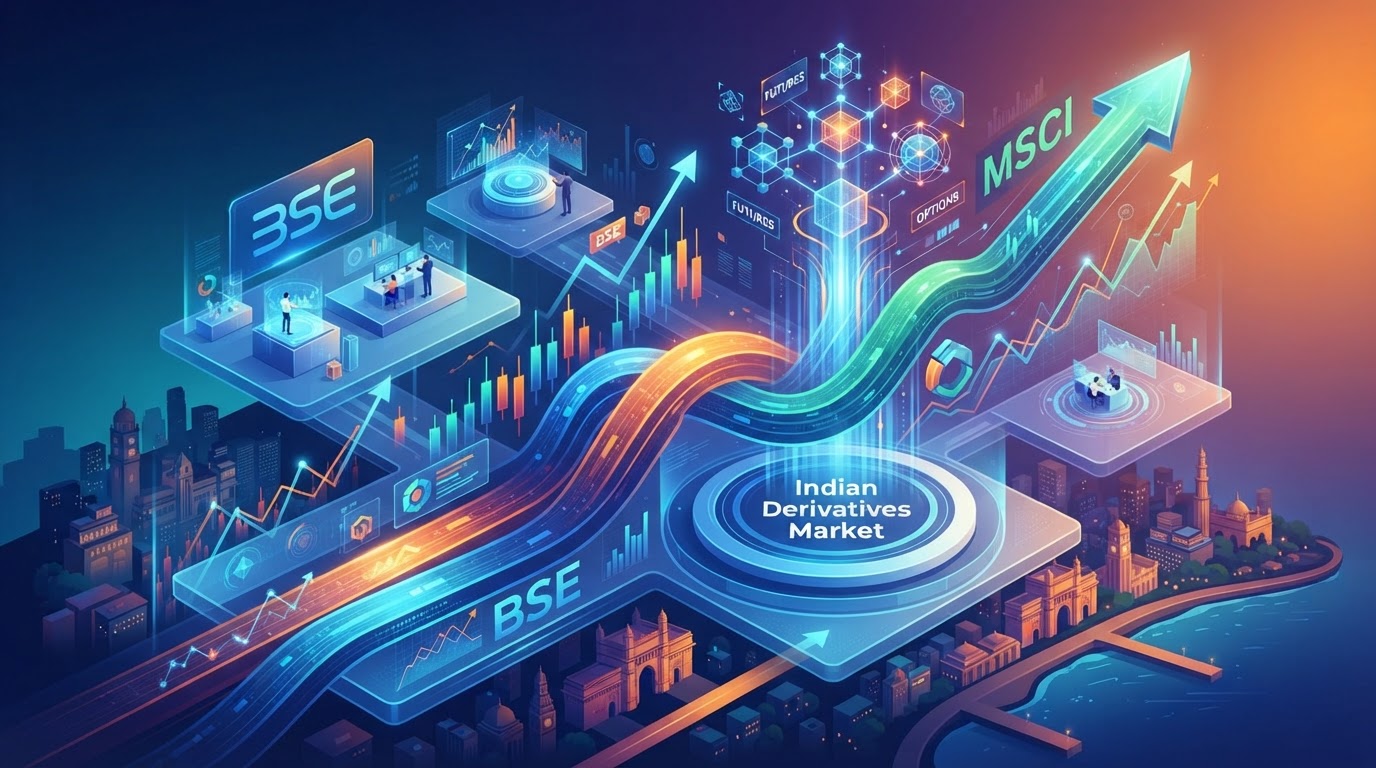
BSE Signs Agreement with MSCI: What Does it Mean for Indian Derivatives?
Key Takeaways
- The BSE's agreement with MSCI allows the exchange to explore offering futures and options contracts linked to global MSCI indexes, a significant step toward internationalizing India's derivatives market.
- These new derivative products will provide Indian investors with efficient tools for global portfolio diversification, hedging international risks, and speculating on worldwide market trends.
- The collaboration is expected to enhance BSE's global standing, attract more foreign institutional investment, and increase liquidity and depth in the Indian derivatives market.
- Regulatory approval from SEBI is a key prerequisite for the launch of these new contracts, with a focus on ensuring market integrity and investor protection.
- Technology will be pivotal in facilitating seamless trading and robust risk management for these sophisticated new offerings, preparing the Indian market for a new era of derivative products.
Understanding the Landmark Collaboration: BSE and MSCI
What is the significance of the BSE's recent agreement with MSCI?
The recent agreement between BSE and MSCI marks a pivotal development for India's financial sector, signifying a concerted effort to introduce sophisticated global derivative products to the domestic exchange. This collaboration aims to allow the BSE to explore and potentially offer futures and options contracts tied to widely recognized MSCI indexes.
The significance of the BSE's recent agreement with MSCI lies in its potential to globalize India's financial offerings and enhance the sophistication of its capital markets. By aligning with a leading global index provider, the BSE is paving the way for Indian investors and market participants to access international benchmarks directly through a domestic exchange, fostering greater market depth and liquidity.
How will this partnership expand India's derivatives market?
This partnership is poised to significantly expand India's derivatives market by introducing a new class of instruments that track global equity performance. Currently, Indian exchanges predominantly offer derivatives on domestic indexes and single stocks; the addition of MSCI-linked products would provide diversification opportunities and hedging tools against global market movements.
The key players involved in this strategic move are the BSE (formerly Bombay Stock Exchange), one of Asia's oldest stock exchanges, and MSCI Inc., a prominent global provider of investment decision support tools, including widely used equity indexes. This alliance leverages BSE's extensive trading infrastructure and MSCI's global brand recognition and intellectual property in index creation.
Who are the key players involved in this strategic move?
Exploring Futures and Options: The Core of the Agreement
What types of derivative contracts are being explored?
The core of the agreement between BSE and MSCI revolves around the exploration and potential introduction of futures and options contracts linked to various MSCI indexes. These derivatives are standardized financial contracts whose value is derived from an underlying asset, in this case, an MSCI index.
The types of derivative contracts being explored are specifically futures and options, which are fundamental instruments in sophisticated financial markets. Futures contracts obligate the buyer to purchase, or the seller to sell, an asset at a predetermined future date and price, while options contracts give the holder the right, but not the obligation, to buy or sell an asset at a specified price within a certain timeframe.
Why are futures and options linked to global indexes so crucial?
Futures and options linked to global indexes are crucial because they offer efficient tools for hedging portfolio risk, speculating on market movements, and gaining exposure to international markets without directly trading foreign securities. They provide a cost-effective way to manage exposure to broad market trends and sector-specific performance on a global scale.
These instruments benefit investors and market participants by enabling them to manage risk exposure to international markets, diversify their portfolios, and potentially enhance returns through strategic positioning. For institutional investors, they offer efficient tools for asset allocation and liability management, while retail investors can use them for directional bets or hedging their existing equity holdings.
How do these instruments benefit investors and market participants?
Potential Impact on India's Financial Landscape
What advantages could this agreement bring to the Indian derivatives market?
The collaboration with MSCI is anticipated to significantly transform India's financial landscape by broadening the range of available investment products and attracting greater international capital. This strategic move aligns with India's ambition to become a more integrated and influential global financial hub.
This agreement could bring several advantages to the Indian derivatives market, including increased liquidity, greater price discovery, and a more diverse array of hedging and investment strategies. The introduction of globally recognized benchmarks could also stimulate innovation in product development and trading technologies within India.
How might this enhance international participation in BSE-listed products?
This partnership might enhance international participation in BSE-listed products by offering familiar, liquid, and globally benchmarked derivatives. Foreign institutional investors (FIIs) who already use MSCI indexes for their global allocations would find it easier to manage their Indian exposures or hedge their global portfolios directly through the BSE, potentially increasing capital inflows.
This collaboration is highly likely to boost BSE's standing in the global financial arena by positioning it as a more attractive and comprehensive trading venue for international investors. By offering products tied to global indexes, the BSE demonstrates its commitment to providing world-class financial instruments, which can elevate its profile among leading exchanges globally. The successful implementation of the BSE signs agreement with MSCI to explore futures, options contracts linked to indexes could solidify its position.
Will this collaboration boost BSE's standing in the global financial arena?
Navigating Regulatory Aspects and Future Outlook
What regulatory considerations are involved in launching new derivative products?
Launching new derivative products in any regulated market, including India, requires careful navigation of various regulatory aspects to ensure market integrity, investor protection, and systemic stability. The Securities and Exchange Board of India (SEBI) will play a crucial role in approving and overseeing these new offerings.
Regulatory considerations involved in launching new derivative products primarily include product design approval, risk management frameworks, surveillance mechanisms, and investor suitability guidelines. SEBI will assess how these new MSCI-linked contracts integrate into the existing market structure, ensuring fair trading practices and preventing market manipulation.
When can we expect the introduction of these new contracts?
While specific timelines are not yet public, the introduction of these new contracts can be expected following successful regulatory approvals and the establishment of necessary trading infrastructure. The exploration phase indicates an intent to launch, but the actual rollout will depend on the speed and thoroughness of the regulatory review process.
The BSE's long-term vision for its derivatives offerings likely involves continuously expanding its product suite to meet evolving investor demands and global market trends. By forging alliances such as the one where BSE signs agreement with MSCI to explore futures, options contracts linked to indexes, the exchange aims to enhance its competitiveness, attract diverse market participants, and solidify its position as a leading financial marketplace in Asia and beyond.
What long-term vision does the BSE have for its derivatives offerings?
Opportunities for Investors and Market Growth
How can Indian investors benefit from these upcoming products?
The introduction of MSCI-linked futures and options presents significant opportunities for Indian investors, enabling them to diversify their portfolios and access global market trends more efficiently from a domestic platform. These products are set to foster greater market growth and sophistication.
Indian investors can benefit from these upcoming products by gaining direct exposure to global equity indexes, which allows for portfolio diversification beyond domestic assets and the ability to hedge against international market volatility. This access can help manage global investment strategies without the complexities of cross-border trading.
What role will technology play in facilitating these new offerings?
Technology will play a crucial role in facilitating these new offerings, particularly in terms of trading platforms, risk management systems, and data dissemination. Advanced trading algorithms, low-latency execution, and robust clearing and settlement systems will be essential to support the expected increase in trading volumes and complexity.
The Indian market is increasingly prepared for increased sophistication in derivatives, driven by a growing investor base, enhanced financial literacy, and robust regulatory oversight. While further education and infrastructure development may be needed, the foundational elements are in place to successfully integrate and manage these advanced financial instruments following the BSE signs agreement with MSCI to explore futures, options contracts linked to indexes.
Is the Indian market prepared for increased sophistication in derivatives?
Frequently Asked Questions
What is the primary goal of the BSE-MSCI agreement?
The primary goal of the BSE-MSCI agreement is to explore and potentially introduce futures and options contracts linked to global MSCI indexes on the BSE platform, thereby expanding India's derivatives market offerings.
Which types of financial instruments are being considered under this agreement?
Under this agreement, the types of financial instruments being considered are futures and options contracts, which are both derivatives whose value is tied to an underlying asset, in this case, MSCI indexes.
How will this collaboration benefit Indian investors?
Indian investors will benefit by gaining access to global market benchmarks for diversification and hedging purposes, allowing them to manage international portfolio risks and opportunities from a domestic exchange.
What role does MSCI play in this agreement?
MSCI, as a leading global index provider, contributes its widely recognized indexes and intellectual property, which will serve as the underlying assets for the new derivative contracts traded on the BSE.
Are these new derivative products immediately available for trading?
No, these new derivative products are not immediately available for trading; the agreement is for exploration, and their introduction is contingent upon regulatory approvals and the establishment of necessary infrastructure.
Will this agreement impact BSE's global market position?
Yes, this agreement is expected to significantly boost BSE's global market position by positioning it as a more comprehensive and attractive venue for international investors, enhancing its competitiveness among global exchanges.
What is the main regulatory body overseeing the launch of these products?
The main regulatory body overseeing the launch of these products in India is the Securities and Exchange Board of India (SEBI), which will be responsible for product approval, market integrity, and investor protection.