
What Does Axis Bank's $300 Million Senior Notes Listing on India INX and NSE IX Mean for Investors?
By IPO Plus
Axis Bank gets final nod to list $300 million senior notes on India INX, NSE IX. Learn what this listing means for investors and market implications. — dates, p
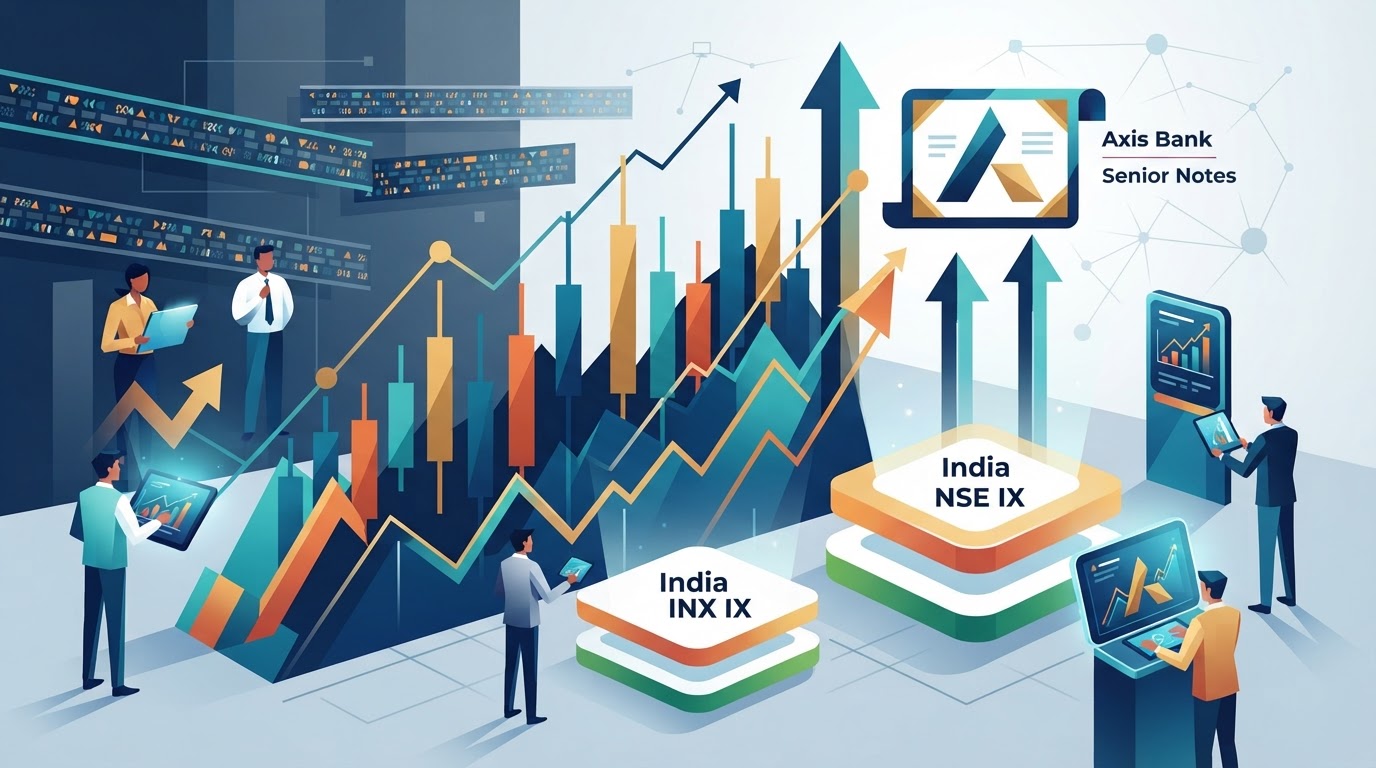
What Does Axis Bank's $300 Million Senior Notes Listing on India INX and NSE IX Mean for Investors?
Key Takeaways
- Axis Bank's listing of $300 million senior notes on India INX and NSE IX is a strategic move to diversify funding, strengthen capital, and access international investors.
- Senior notes offer a lower-risk investment compared to equity, providing fixed income and prioritized repayment in case of liquidation, appealing to institutional fixed-income investors.
- Dual listing on India INX and NSE IX maximizes global visibility and liquidity for the notes, leveraging both international exchanges in GIFT City for broader investor reach.
- This initiative strengthens Axis Bank's financial position, enables growth, and sets a precedent for other Indian institutions seeking to raise capital from overseas markets.
- Investors should assess Axis Bank's creditworthiness, currency risk, and the specific terms of the notes, differentiating this debt investment from equity holdings.
Understanding Axis Bank's Latest Financial Move
What are Senior Notes and How Do They Work?
Axis Bank has received final approval to list $300 million senior notes on India INX and NSE IX, marking a significant step in its financial strategy. This move involves the issuance of specific debt instruments to raise capital from international markets. Such financial maneuvers by major Indian banks often signal broader trends within the nation's economic landscape and its engagement with global finance.
Senior notes are debt instruments that financial institutions or corporations issue to raise capital. These notes are considered 'senior' because, in the event of a company's liquidation, holders of these notes are prioritized for repayment over other creditors, such as junior bondholders or equity shareholders. This preferential treatment generally translates into a lower risk profile for investors compared to equity, and consequently, a typically lower yield. They offer a fixed income stream and a repayment of principal at maturity, making them attractive to investors seeking predictable returns. For Axis Bank, these notes represent a specific form of borrowing.
Why is Axis Bank Issuing These Notes?
Axis Bank is issuing these senior notes primarily to bolster its capital base and diversify its funding sources. Raising $300 million through this mechanism allows the bank to access international capital markets, potentially securing funds at more favorable rates than might be available domestically. This strategy supports the bank's operational growth, expansion plans, and overall financial stability, ensuring it has the necessary resources to meet regulatory requirements and pursue strategic initiatives. The issuance also helps Axis Bank to manage its asset-liability structure more effectively.
The Significance of Listing on India INX and NSE IX
What is India INX and Why is it Important for Global Capital?
The decision by Axis Bank to list its $300 million senior notes on both India INX and NSE IX underscores a strategic effort to enhance global visibility and accessibility for its debt instruments. These exchanges play a crucial role in connecting Indian entities with international investors, facilitating cross-border capital flows.
India INX, located in Gujarat International Finance Tec-City (GIFT City), is India's first international exchange and operates 22 hours a day, six days a week, catering to a global investor base. Its importance for global capital lies in its ability to offer a platform for Indian and international issuers to raise capital in foreign currencies, outside the purview of domestic market regulations for certain transactions. This makes it an attractive venue for international investors seeking exposure to Indian assets, providing a streamlined and efficient mechanism for cross-border financial transactions. The listing of Axis Bank's senior notes on India INX enhances their accessibility to a wider international audience.
How Does NSE IX Contribute to International Fundraising?
NSE IX, also situated in GIFT City, is another international exchange that complements India INX in facilitating international fundraising for Indian companies. By listing on NSE IX, Axis Bank further expands its reach to a diverse pool of global investors. These international exchanges provide a sophisticated infrastructure for trading and settlement, aligning with global standards and enhancing investor confidence. The presence on NSE IX means that the $300 million senior notes are available to a broader array of institutional investors and funds looking for international debt opportunities linked to the Indian market.
A dual listing strategy, such as Axis Bank's decision to list its $300 million senior notes on both India INX and NSE IX, offers several distinct advantages. Primarily, it maximizes the visibility and liquidity of the debt instruments by making them accessible on multiple international platforms. This broadens the investor base, potentially leading to more competitive pricing and better terms for the issuer. Secondly, it signals a commitment to transparency and adherence to international financial standards, which can bolster investor confidence. Finally, it leverages the unique strengths and investor networks of each exchange, optimizing the chances of successful capital raising and efficient secondary market trading for the senior notes.
What are the Benefits of a Dual Listing Strategy?
Impact on Axis Bank and the Indian Financial Landscape
How Might This Listing Strengthen Axis Bank's Financial Position?
The successful listing of Axis Bank's $300 million senior notes on India INX and NSE IX is poised to have significant repercussions, not only for the bank itself but also for the wider Indian financial sector. This strategic move could redefine how Indian entities approach global capital markets.
This listing can significantly strengthen Axis Bank's financial position by providing it with a substantial injection of foreign currency funds. These funds can be utilized for various purposes, including bolstering its capital adequacy ratios, financing international operations, or expanding its loan book for foreign currency-denominated credits. Accessing capital from international markets diversifies the bank's funding mix, reducing reliance on domestic sources and potentially lowering its overall cost of capital. Furthermore, successful international debt issuances enhance the bank's reputation and credit standing on a global stage, making future fundraising efforts more efficient. The $300 million senior notes enhance the bank's liquidity and operational flexibility.
What are the Broader Implications for Indian Banking Sector Accessing Overseas Capital?
The broader implications for the Indian banking sector accessing overseas capital are profound. Axis Bank's move with its $300 million senior notes serves as a powerful precedent, demonstrating the viability and benefits of leveraging international exchanges like India INX and NSE IX for fundraising. This could pave the way for other Indian banks to explore similar avenues, leading to a greater internationalization of India's financial system. Increased access to overseas capital can help Indian banks meet the growing demands for credit in a rapidly expanding economy, improve their capital buffers, and enhance their competitiveness on a global scale. It also exposes Indian banks to international best practices in terms of disclosure and governance.
Yes, it is highly likely that this move by Axis Bank to list $300 million senior notes on international exchanges will become a trend for other Indian institutions, particularly those with a significant international presence or ambitious growth plans. As the Indian economy continues to integrate with global markets, the need for diversified and cost-effective funding sources will intensify. The success of large institutions like Axis Bank in raising capital through these channels provides a blueprint and builds confidence for others. We can anticipate more Indian banks, and even large corporations, considering similar listings on India INX and NSE IX to tap into global liquidity pools and optimize their capital structures.
Is This a Trend for Other Indian Institutions?
Potential Opportunities and Risks for Investors
Who Can Invest in These Senior Notes?
Investing in Axis Bank's $300 million senior notes presents a distinct set of opportunities and risks for a specific segment of the investor community. Understanding these nuances is crucial for making informed investment decisions.
Generally, senior notes such as those issued by Axis Bank are targeted towards institutional investors, high-net-worth individuals, and sophisticated investors who have the capacity to invest in debt instruments listed on international exchanges. These could include pension funds, mutual funds, sovereign wealth funds, and other financial institutions looking for fixed-income exposure to emerging markets. Retail investors typically have limited direct access to such instruments due to minimum investment thresholds and regulatory requirements associated with international listings. The listing on India INX and NSE IX caters to this global institutional investor base.
What Should Investors Consider Before Participating?
Before participating in the investment of these senior notes, investors should carefully consider several factors. Key considerations include the creditworthiness of Axis Bank, the prevailing interest rate environment, and the specific terms and conditions of the notes, such as coupon rate, maturity date, and call provisions. Investors should also assess currency risk, as these notes are denominated in USD, meaning fluctuations in the USD-INR exchange rate could impact returns for non-USD-based investors. Liquidity on the secondary market, though enhanced by dual listing, should also be evaluated. Furthermore, understanding the regulatory framework governing these notes on India INX and NSE IX is essential. The $300 million senior notes require due diligence.
Investing in Axis Bank's senior notes differs fundamentally from equity investments in the bank. Senior notes represent a debt obligation, offering fixed or floating interest payments and the return of principal at maturity. This provides a more predictable income stream and a higher position in the capital structure during liquidation, implying lower risk compared to equity. Equity investments, on the other hand, represent ownership in the bank, offering potential for capital appreciation and dividends but also carrying higher risk and volatility. Equity investors have voting rights and benefit directly from the bank's growth, while noteholders primarily receive their scheduled payments. The $300 million senior notes are a debt instrument, not an equity share.
How Does This Differ from Equity Investments in Axis Bank?
Future Outlook: What's Next for Axis Bank and Indian Capital Markets?
How Might This Affect Axis Bank's Growth Strategy?
The successful listing of Axis Bank's $300 million senior notes is not merely a standalone transaction; it has significant implications for the bank's long-term growth trajectory and the broader internationalization of Indian capital markets.
This successful fundraising through the $300 million senior notes can significantly bolster Axis Bank's growth strategy by providing a stable and substantial source of long-term funding. It enables the bank to pursue ambitious expansion plans, whether through organic growth in its lending portfolio, strategic acquisitions, or investment in new technologies and digital transformation initiatives. Having diversified access to international capital markets reduces dependency on domestic funding cycles and allows for more aggressive and sustained growth, especially in segments requiring foreign currency financing. This financial flexibility empowers Axis Bank to strengthen its competitive position and achieve its strategic objectives more effectively.
What Does This Mean for the Internationalization of Indian Financial Instruments?
The listing of Axis Bank's $300 million senior notes on international exchanges like India INX and NSE IX marks a crucial step in the internationalization of Indian financial instruments. It demonstrates the increasing willingness and capability of Indian institutions to tap into global capital pools, adhering to international standards of disclosure and governance. This trend enhances the visibility and attractiveness of Indian debt and equity instruments to a worldwide investor base, fostering greater foreign direct and portfolio investment into India. It facilitates a more integrated global financial ecosystem, where Indian entities can raise capital and manage risk efficiently on international platforms. This contributes to making Indian financial instruments more commonplace in global investment portfolios.
Yes, it is highly probable that more Indian companies will follow this path, particularly given the growing sophistication of India's financial markets and the increasing global interest in Indian economic growth. The success stories of major players like Axis Bank in listing senior notes on international exchanges will serve as a strong incentive for other large corporations, infrastructure companies, and even public sector undertakings to explore similar avenues. As India continues its economic reforms and integrates further into the global economy, accessing diverse and cost-effective international capital will become a standard practice for ambitious Indian enterprises aiming for scale and global competitiveness. The precedent set by Axis Bank gets final nod to list $300 million senior notes on India INX, NSE IX is significant for future capital raising efforts.
Will We See More Indian Companies Following This Path?
Frequently Asked Questions
What are senior notes?
Senior notes are debt instruments that typically have priority in repayment over other creditors if a company undergoes liquidation, offering a fixed income stream and principal repayment at maturity.
Why is Axis Bank issuing $300 million senior notes?
Axis Bank is issuing these senior notes to diversify its funding sources, bolster its capital base, support its growth strategies, and access international capital markets for potentially more favorable rates.
What is India INX?
India INX is India's first international stock exchange, located in GIFT City, providing a platform for Indian and international issuers to raise capital in foreign currencies, open almost 24/7.
How does NSE IX differ from India INX?
NSE IX is another international exchange in GIFT City, similar to India INX, that facilitates international fundraising for Indian companies, contributing to a broader international investor base and sophisticated trading infrastructure.
Who can invest in Axis Bank's senior notes?
These senior notes are primarily aimed at institutional investors, high-net-worth individuals, and sophisticated investors globally, due to their nature as debt instruments listed on international exchanges.
How does this listing impact the Indian banking sector?
This listing sets a precedent for other Indian banks to access overseas capital more readily, enhancing their capital buffers, diversifying funding, and contributing to the internationalization of India's financial system.
What are the main risks for investors in these notes?
Key risks for investors include Axis Bank's credit risk, prevailing interest rate fluctuations, currency risk (as the notes are USD-denominated), and the liquidity of the notes in the secondary market.