
Why Do Retail Traders Lose Money in Options Trading? A Deep Dive for Indian Investors
By IPO Plus
Discover why retail traders lose money in options trading. Learn the key mistakes, risk management strategies, and insights tailored for Indian investors.
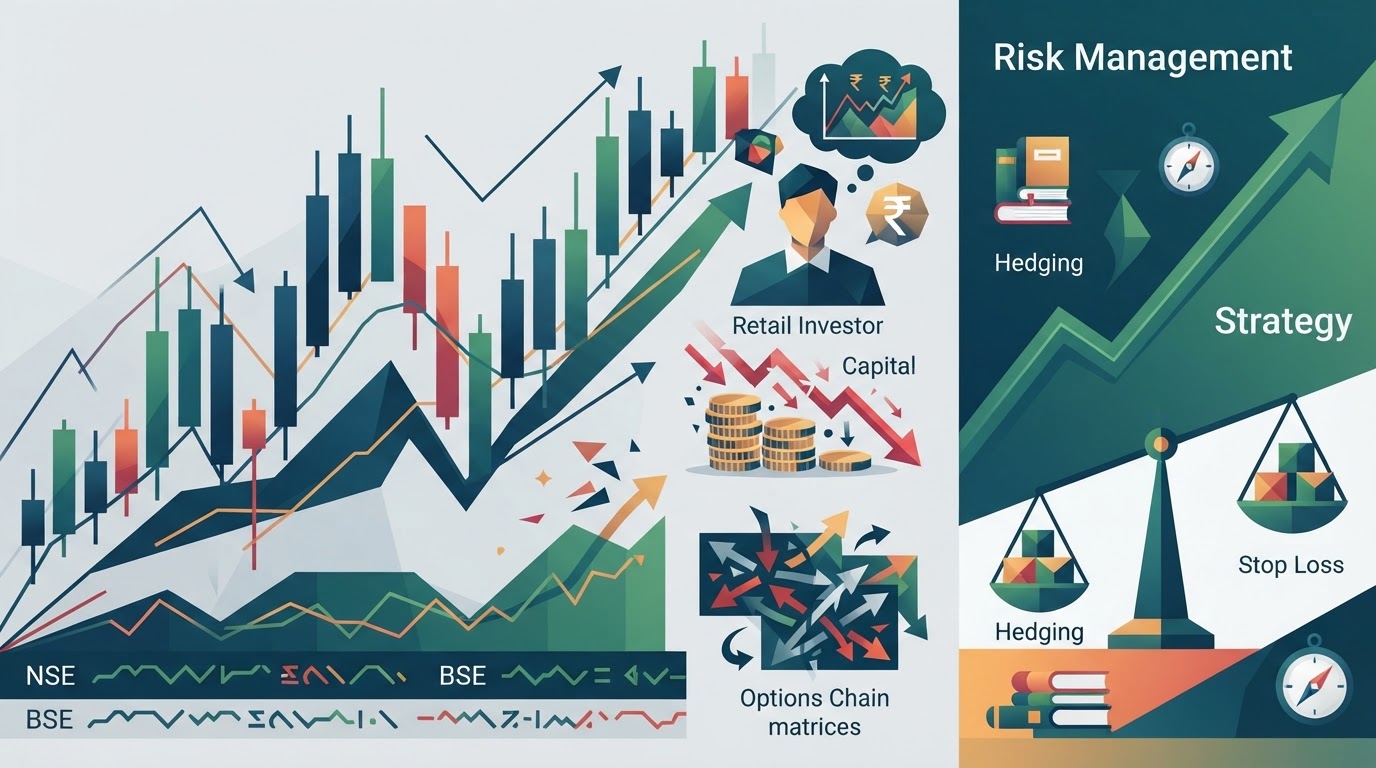
Why Do Retail Traders Lose Money in Options Trading? A Deep Dive for Indian Investors
Key Takeaways
- Most retail traders lose money in options trading due to a lack of fundamental understanding, inadequate risk management, and emotional decision-making.
- The allure of high leverage and perceived low capital requirements often leads to unrealistic expectations and a 'get rich quick' mentality.
- Common mistakes include trading without a defined strategy, misunderstanding volatility and time decay (Theta), and blindly following unverified tips.
- To improve success, Indian retail traders must prioritize education, utilize paper trading, and implement strict risk management practices.
- Developing a disciplined trading strategy and maintaining emotional control are crucial for consistent profitability and capital preservation in options.
What Exactly is Options Trading, and How Does it Work?
Demystifying Calls and Puts: The Basics of Options Contracts
Options trading involves financial derivatives that give the buyer the right, but not the obligation, to buy or sell an underlying asset at a specified price before or on a certain date. This form of trading can offer significant leverage but also carries substantial risks, particularly for those who are new to the financial markets.
Options contracts derive their value from an underlying asset, such as stocks, indices, or commodities. Understanding the mechanics of these contracts is crucial for anyone considering options trading.
Understanding Strike Prices, Expiry Dates, and Premiums
Demystifying Calls and Puts: The Basics of Options Contracts Options contracts are primarily categorized into two types: calls and puts. A call option gives the holder the right to buy an underlying asset at a specified price (the strike price) before or on a specific date (the expiry date). Investors typically buy call options when they anticipate an increase in the price of the underlying asset. Conversely, a put option grants the holder the right to sell an underlying asset at a specified price before or on a specific date. Traders usually purchase put options when they expect the price of the underlying asset to decline. Both call and put options can also be sold (written), which creates an obligation for the seller.
Understanding Strike Prices, Expiry Dates, and Premiums The strike price is the predetermined price at which the underlying asset can be bought or sold when an option is exercised. The expiry date is the last day an option contract is valid; after this date, the option becomes worthless if not exercised or closed. The premium is the price an option buyer pays to the option seller for the rights granted by the contract. This premium is influenced by several factors, including the underlying asset's price, the strike price, the time to expiry, interest rates, and the volatility of the underlying asset.
How is Options Trading Different from Equity Trading?
How is Options Trading Different from Equity Trading? Options trading differs significantly from equity trading in several fundamental ways. When an investor buys an equity share, they own a piece of the company and participate directly in its growth or decline. Equity ownership typically has no expiry date. In contrast, options trading deals with contracts that have a limited lifespan and derive their value from an underlying asset without conferring ownership of that asset. Options provide leverage, meaning a small price movement in the underlying asset can lead to a much larger percentage gain or loss in the option's value. This leverage, while attractive for potential gains, also magnifies potential losses, which is a key reason why retail traders lose money in options trading.
Why Are Options So Attractive (and Dangerous) to Retail Traders?
The Allure of High Leverage and Potentially Quick Profits
Options are exceptionally attractive to retail traders due to the promise of high returns with relatively low upfront capital, yet these very features also make them incredibly dangerous. The inherent leverage and quick profit potential often overshadow the significant risks involved for many individual investors.
Many Indian retail traders are drawn to options trading hoping for substantial gains in a short period. This often leads to underestimating the complexities and risks involved, contributing to the high rate of losses.
Perceived Low Capital Requirement and Accessibility
The Allure of High Leverage and Potentially Quick Profits One of the most compelling reasons retail traders are drawn to options is the high leverage they offer. With options, a small capital outlay can control a much larger value of the underlying asset. This means that a minor percentage move in the underlying asset's price can translate into a significant percentage gain or loss in the option's value. The prospect of quick profits from these leveraged positions creates a powerful allure, especially for those looking to rapidly grow their capital.
Perceived Low Capital Requirement and Accessibility Options contracts often appear to have a low barrier to entry in terms of capital required compared to buying the equivalent number of shares outright. This perceived accessibility makes options trading appealing to individuals with smaller trading accounts. Many believe they can start with a modest sum and quickly compound their capital, not fully grasping that while the initial outlay might be small, the potential for losing that entire amount, and sometimes even more, is very real.
The 'Get Rich Quick' Fallacy: Unrealistic Expectations
The 'Get Rich Quick' Fallacy: Unrealistic Expectations The 'get rich quick' mentality is a significant factor in why retail traders lose money in options trading. Many new traders enter the market with unrealistic expectations, believing that options will be a fast track to wealth. They are often swayed by stories of large, rapid profits, ignoring the equally common stories of significant losses. This fallacy prevents traders from adopting a disciplined approach, fostering impulsive decisions, and leading them to take on excessive risk in pursuit of improbable gains.
What are the Primary Reasons Indian Retail Traders Lose Money in Options?
Lack of Fundamental Understanding and Proper Education
Indian retail traders primarily lose money in options due to a combination of inadequate knowledge, poor risk management practices, and unchecked emotional responses. These factors collectively create a challenging environment for consistent profitability.
Understanding these core issues is the first step toward improving trading outcomes. Many traders jump into options without a solid foundation, leading to predictable pitfalls.
Ignoring Risk Management: Overleveraging and Position Sizing
Lack of Fundamental Understanding and Proper Education A significant reason why retail traders lose money in options trading is a lack of fundamental understanding and proper education. Many traders enter the options market without fully grasping the complex dynamics of option pricing, the Greeks (Delta, Gamma, Theta, Vega), or the various strategies available. They might understand the basic concept of calls and puts but fail to comprehend the nuances of how time decay or volatility impacts their positions. This knowledge gap often leads to making uninformed decisions based on incomplete information or speculation.
Ignoring Risk Management: Overleveraging and Position Sizing Ignoring robust risk management strategies, particularly overleveraging and improper position sizing, is a critical contributor to losses. Many retail traders commit a disproportionately large percentage of their capital to a single trade, amplifying potential losses. They might use the maximum available leverage without understanding the implications, leading to rapid capital depletion when trades move against them. Effective risk management dictates that no single trade should jeopardize a significant portion of the trading capital, a principle often overlooked by novice options traders.
Emotional Trading: Fear, Greed, and Impulsive Decisions
Emotional Trading: Fear, Greed, and Impulsive Decisions Emotional trading, driven by fear and greed, leads to impulsive and irrational decisions that devastate trading accounts. The fear of missing out (FOMO) can push traders into high-risk positions without proper analysis, while greed can lead them to hold onto winning trades for too long, only to see profits evaporate or turn into losses. Conversely, fear of further losses can cause traders to exit profitable positions prematurely or panic-sell at the worst possible time. Controlling these emotions through discipline and a predefined trading plan is essential for sustained success in options trading.
Are There Common Mistakes Options Traders Make That Lead to Losses?
Trading Without a Solid Strategy: The Absence of a Trading Plan
Several common mistakes consistently lead options traders to incur losses, ranging from a lack of strategic planning to a fundamental misunderstanding of market mechanics. Identifying and avoiding these errors is crucial for improving trading performance.
Many pitfalls in options trading are avoidable with proper preparation and skepticism. Retail traders often fall into these traps due to overconfidence or a lack of critical thinking.
Misunderstanding Volatility and Time Decay (Theta)
Trading Without a Solid Strategy: The Absence of a Trading Plan Trading without a solid, well-defined strategy is a pervasive mistake among retail options traders. A trading plan outlines entry and exit criteria, risk parameters, and profit targets for every trade. Without such a plan, traders often make ad-hoc decisions based on intuition or fleeting market sentiment, which rarely leads to consistent profitability. The absence of a systematic approach means traders are reacting to the market rather than proactively executing a researched strategy, significantly increasing the likelihood of losses.
Misunderstanding Volatility and Time Decay (Theta) Many retail traders misunderstand the crucial concepts of volatility and time decay (Theta), leading to suboptimal trading decisions. Volatility, a measure of price fluctuation, significantly impacts option premiums; higher volatility generally means higher premiums for both calls and puts. Time decay, or Theta, represents the erosion of an option's value as it approaches its expiry date. Options are depreciating assets due to Theta, meaning their value decreases day by day, all else being equal. Traders who buy options without accounting for rapid time decay, especially out-of-the-money options close to expiry, often see their capital vanish, which explains why retail traders lose money in options trading frequently.
Falling for Tips and 'Guaranteed' Strategies Without Due Diligence
Falling for Tips and 'Guaranteed' Strategies Without Due Diligence Falling for unverified tips and promises of 'guaranteed' strategies without conducting thorough due diligence is a common and costly mistake. The options market is complex, and no strategy can guarantee profits. Retail traders, eager for quick gains, often rely on advice from social media, unverified online gurus, or dubious 'signals' without understanding the underlying logic or associated risks. True success in options trading comes from independent research, continuous learning, and developing one's own well-tested strategies, not from blindly following others.
How Can Indian Retail Traders Improve Their Chances of Success in Options?
Prioritizing Education and Practicing with Paper Trading
Indian retail traders can significantly improve their success rates in options trading by focusing on comprehensive education, rigorous risk management, and the development of a disciplined trading approach. These pillars are fundamental to navigating the complexities of the options market.
Adopting a structured and patient approach is vital for overcoming the common pitfalls and transforming options trading into a potentially profitable endeavor.
Implementing Strict Risk Management and Capital Preservation
Prioritizing Education and Practicing with Paper Trading Prioritizing comprehensive education is the cornerstone of success in options trading. This involves learning about different option strategies, understanding the 'Greeks,' and comprehending market dynamics. Complementing this theoretical knowledge with practical experience through paper trading (simulated trading) is crucial. Paper trading allows traders to test strategies, understand market reactions, and gain confidence without risking real capital. It provides a safe environment to make mistakes and learn from them, helping to build a robust foundation before entering the live market.
Implementing Strict Risk Management and Capital Preservation Implementing strict risk management protocols and focusing on capital preservation are non-negotiable for any successful options trader. This includes defining the maximum percentage of capital to risk per trade, setting stop-loss orders to limit potential losses, and proper position sizing. Traders should never risk more than a small fraction of their total trading capital on a single trade. Consistently adhering to these rules helps protect the trading account from significant drawdowns and ensures longevity in the market, a critical factor for why retail traders lose money in options trading when neglected.
Developing a Disciplined Trading Strategy and Emotional Control
Developing a Disciplined Trading Strategy and Emotional Control Developing and strictly adhering to a disciplined trading strategy, coupled with strong emotional control, is essential. A well-defined strategy should include clear entry and exit points, profit targets, and stop-loss levels. Once a strategy is established, traders must resist the urge to deviate from it based on emotion. Practicing mindfulness and self-awareness can help manage fear, greed, and impulsive behavior. By maintaining discipline, executing trades according to plan, and avoiding emotional decisions, traders can significantly improve their consistency and overall profitability in the dynamic options market.
Frequently Asked Questions
What is options trading?
Options trading involves financial contracts that grant the buyer the right, but not the obligation, to buy or sell an underlying asset at a specific price on or before a certain date.
Why are options considered high risk?
Options are considered high risk due to their inherent leverage, which can magnify both gains and losses, and their limited lifespan, meaning they can expire worthless.
What is a 'call' option?
A call option gives the holder the right to buy an underlying asset at a specified price (strike price) by a specific date (expiry date), typically bought when expecting the asset's price to rise.
What is a 'put' option?
A put option gives the holder the right to sell an underlying asset at a specified price (strike price) by a specific date (expiry date), typically bought when expecting the asset's price to fall.
What is time decay (Theta) in options?
Time decay, or Theta, refers to the decrease in an option's value as it approaches its expiry date, all other factors remaining constant. Options are depreciating assets due to Theta.
How can retail traders reduce losses in options trading?
Retail traders can reduce losses by gaining comprehensive education, practicing with paper trading, implementing strict risk management, and developing a disciplined trading strategy.
Is options trading suitable for beginners?
Options trading is generally not recommended for beginners without significant prior education, understanding of market dynamics, and a robust risk management plan, due to its complexity and high-risk nature.