
SL vs. SL-M Orders: What's the Difference and Why Does it Matter to Indian Investors?
By IPO Plus
Learn the difference between SL and SL-M order in trading. Understand how stop-loss and stop-loss market orders work for Indian investors. — dates, price band,
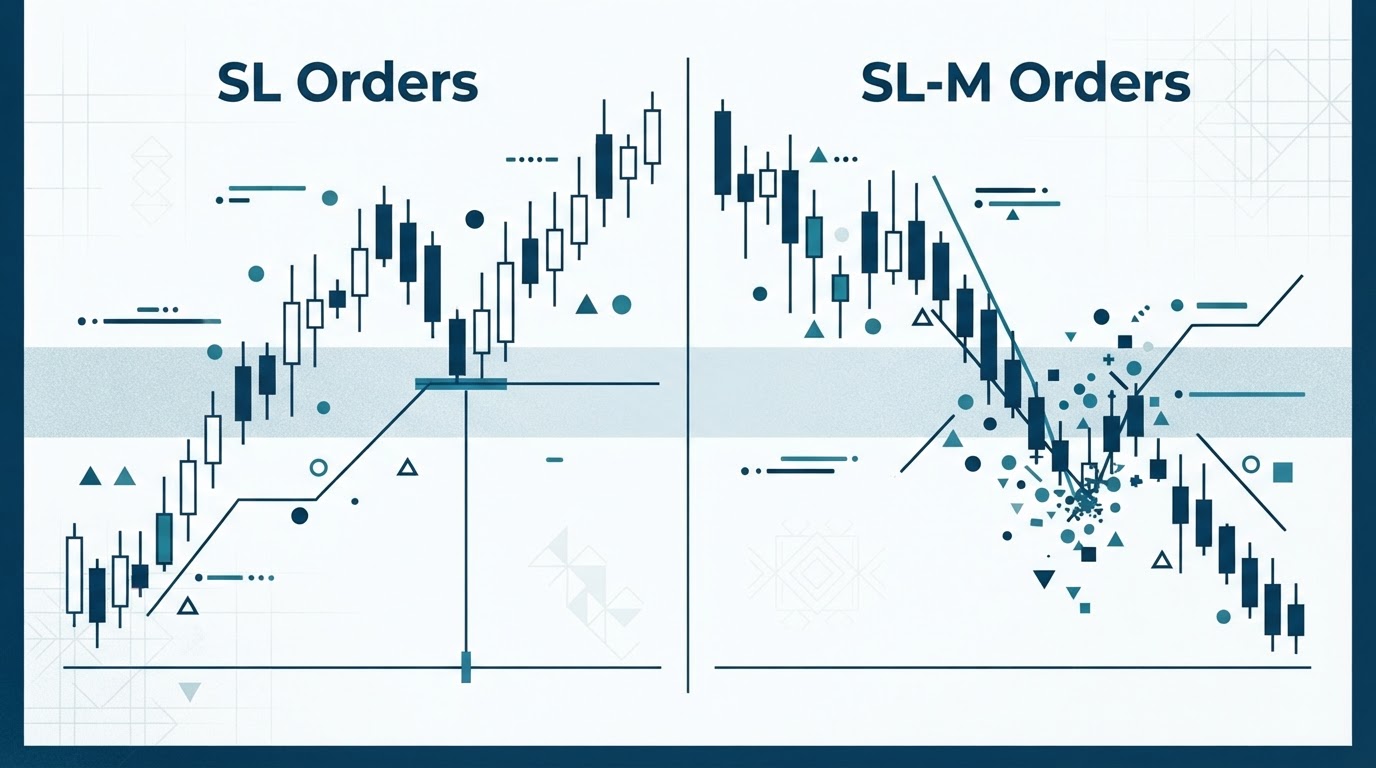
SL vs. SL-M Orders: What's the Difference and Why Does it Matter to Indian Investors?
Key Takeaways
- SL orders become limit orders when triggered, offering price control but not guaranteed execution, making them suitable for liquid stocks.
- SL-M orders become market orders when triggered, guaranteeing execution but at the best available price, which may involve significant slippage, particularly in volatile or illiquid markets.
- Understanding the difference between SL and SL-M orders is crucial for Indian traders to manage risk effectively, as the choice impacts whether price certainty or execution certainty is prioritized.
- For highly liquid large-cap stocks, an SL order is generally appropriate, while an SL-M order is often essential for illiquid securities like many SME IPO shares to ensure an exit.
- Effective stop-loss placement requires a combination of technical analysis, risk management principles, and an awareness of common pitfalls like setting stops too tightly or too loosely.
What are Stop-Loss (SL) Orders and How Do They Work?
How do SL orders protect your capital in volatile markets?
A Stop-Loss (SL) order is an instruction given to a broker to sell a security once its price reaches a specified limit, known as the stop price. The primary purpose of an SL order is to limit potential losses on an investment position by automatically triggering a trade when a predefined price threshold is breached.
SL orders function as a conditional limit order. When an SL order's stop price is triggered, it converts into a limit order at the price specified by the trader. This means the trade will execute only if the market price is at or better than the limit price set, preventing a sale at a significantly worse price than intended.
When should an Indian trader use a Stop-Loss order?
Indian traders frequently use SL orders in both equity and derivatives segments to manage risk. For instance, if an investor buys shares at ₹100 and sets a stop-loss at ₹95, the broker will place a sell limit order once the share price falls to or below ₹95. This mechanism helps in exiting a losing position before losses become substantial.
Stop-Loss orders protect capital in volatile markets by pre-defining the maximum acceptable loss on a trade, providing a safety net against sharp price reversals. In the unpredictable Indian market, where specific news or global events can cause rapid price swings, an SL order ensures that a position is automatically closed if the market moves unfavorably beyond a certain point. This mechanical approach removes emotional decision-making from loss mitigation, allowing investors to adhere to their risk management plan even during stressful market conditions. Investors who anticipate significant market movements, such as during earnings announcements or geopolitical events, often deploy SL orders to shield their portfolios.
Are there any limitations or risks with standard SL orders?
An Indian trader should use a Stop-Loss order primarily to limit potential losses on a stock or derivative position. This type of order is particularly useful for traders who cannot monitor the market continuously or who want to automate their risk management. For example, a positional trader holding shares overnight might place an SL order to protect against a significant gap down opening. Intraday traders also use SL orders to define their maximum per-trade loss, ensuring they don’t deviate from their predefined risk parameters in fast-moving market environments. Furthermore, SL orders are invaluable for protecting profits by progressively raising the stop price as the stock moves favorably, a strategy known as a 'trailing stop-loss'.
There are several limitations and risks associated with standard Stop-Loss orders that Indian traders should be aware of. The primary risk is that a standard SL order, once triggered, becomes a limit order, which means there is no guarantee of execution. If the market moves very quickly past the specified limit price, the order may not be filled, or it may be partially filled, leaving the trader exposed to further losses. This can happen during sudden market crashes, circuit breakers, or after significant news events. Additionally, setting the stop price too close to the current market price can lead to premature exits, known as being 'stopped out', due to normal market fluctuations, causing traders to miss out on subsequent rallies.
Understanding Stop-Loss Market (SL-M) Orders in Indian Trading
What makes an SL-M order different from a regular SL order?
A Stop-Loss Market (SL-M) order is an instruction to a broker to sell a security at the best available market price once its price reaches or breaches a specified stop price. Unlike a regular SL order, an SL-M order does not convert into a limit order; it converts into a market order.
The critical distinction between SL and SL-M orders lies in their execution guarantee versus price certainty. An SL-M order prioritizes execution. Once the stop price is triggered, the order immediately becomes a market order and is filled at the next available price, regardless of how far it deviates from the stop price.
How does an SL-M order ensure execution near your stop price?
This type of order is particularly useful in illiquid shares or during periods of high volatility, where ensuring an exit is more important than getting a specific price. For example, if an investor holds an SME IPO share and wants to limit losses, an SL-M order might be preferred to ensure an exit, even if the price slips significantly.
An SL-M order differs from a regular SL order primarily in its execution mechanism after the stop price is triggered. A regular SL order, once triggered, converts into a limit order, which guarantees a price (or better) but not necessarily execution. Conversely, an SL-M order, upon triggering its stop price, converts into a market order, which guarantees execution at the best available current market price but does not guarantee the execution price. This means an SL-M order prioritizes filling the order over achieving a specific price, making it a powerful tool for ensuring an exit from a position.
When is an SL-M order the preferred choice for Indian investors?
An SL-M order ensures execution near your stop price by converting into a market order immediately when the stop price is reached or crossed. When this conversion occurs, the market order is matched with the best available bid price (for a sell order) or ask price (for a buy order) in the order book. While it aims for the earliest possible execution, especially in liquid markets, the actual fill price can deviate from the stop price due to 'slippage', particularly in volatile or illiquid conditions. Slippage refers to the difference between the expected price of a trade and the price at which the trade actually executes. In fast-moving markets, the price can move significantly between the trigger and execution.
An SL-M order is the preferred choice for Indian investors in situations where guaranteed execution is paramount over achieving a specific price target. This often includes trading highly illiquid stocks, such as certain SME IPO listings, or managing risk in extremely volatile markets where prices can gap up or down rapidly. Investors might also prefer an SL-M order when trying to cut losses quickly in a rapidly falling market, as it ensures an exit before potential further declines. Furthermore, in algorithmic trading or for traders with a strict loss-cutting policy, an SL-M order provides certainty of exiting a position once the risk threshold is breached, preventing the order from remaining unfilled if the market moves beyond its limit price.
SL vs. SL-M: Key Differences for Traders in India
What are the primary operational distinctions between SL and SL-M?
The core difference between SL and SL-M orders for traders in India lies in their behavior once the stop price is triggered, impacting price certainty versus execution guarantee. Understanding this distinction is crucial for effective risk management.
The primary operational distinctions between SL and SL-M orders revolve around the order type generated upon trigger and their implications for execution. An SL order, once its stop price is hit, becomes a limit order, specifying a maximum (for buy) or minimum (for sell) price at which the trade can be executed. This means it might not execute if the market rapidly moves past the specified limit. An SL-M order, conversely, transforms directly into a market order upon hitting its stop price, instructing the broker to execute at the best available price immediately. This guarantees execution but provides no control over the final price received.
How does market volatility impact the effectiveness of each order type?
Market volatility significantly impacts the effectiveness of both SL and SL-M order types. In highly volatile markets, an SL order carries a higher risk of not being filled, or only partially filled, especially if the price rapidly gaps past the set limit price before the order can be matched. This leaves the trader exposed to further potential losses beyond their intended stop. For an SL-M order, high volatility can lead to substantial 'slippage', where the actual execution price deviates significantly from the stop price. While execution is guaranteed, the trade might occur at a much worse price than anticipated. Therefore, in volatile conditions, traders must carefully consider the trade-off between price certainty (SL) and execution guarantee (SL-M).
When comparing Stop-Loss (SL) and Stop-Loss Market (SL-M) orders, the SL order offers better price certainty because it converts into a limit order, allowing the trader to specify the maximum or minimum acceptable execution price. However, this comes at the cost of potential non-execution if the market price deviates too much. Conversely, the SL-M order offers guaranteed execution because it converts into a market order, ensuring the trade is filled at the best available price. While execution is assured, there is no guarantee regarding the execution price, making it susceptible to slippage, particularly in fast-moving or illiquid markets. Therefore, traders must weigh their priorities: control over price or certainty of closing the position.
Which order type offers better price certainty, and which offers guaranteed execution?
Practical Scenarios: When to Use SL vs. When to Use SL-M
Should I use an SL order for highly liquid large-cap stocks?
Choosing between an SL and an SL-M order depends heavily on market conditions, the liquidity of the security, and the trader's risk appetite and objectives.
For highly liquid large-cap stocks, an SL order is generally a suitable choice. These stocks typically have tight bid-ask spreads and high trading volumes, meaning that when an SL order triggers and converts to a limit order, there's a high probability of it executing near the specified stop price. The market's depth ensures that sufficient buyers or sellers are usually available at prices close to your limit. This allows traders to benefit from price protection without excessive slippage, making it effective for disciplined risk management in stable or moderately volatile conditions. However, in extreme, rapid market movements (like 'flash crashes'), even highly liquid stocks can gap, and an SL order might not execute.
When is an SL-M order essential for illiquid SME IPO shares?
An SL-M order becomes essential for illiquid SME IPO shares or other thinly traded securities where volume is low and bid-ask spreads are wide. In such markets, a regular SL order (which becomes a limit order) might never execute if the price gaps down significantly past your limit price without finding a counterparty at or above that price. The guaranteed execution of an SL-M order ensures that you can exit your position, even if it means accepting a less favorable price. For new listings, especially in the SME segment, price discovery can be volatile, making SL-M a crucial tool for traders prioritizing an exit over a specific price point during adverse movements.
There are distinct strategies for Intraday vs. Positional Trading when using SL and SL-M orders. For intraday trading, where positions are closed within the same day, traders often prioritize quick exits. In fast-paced intraday markets, an SL-M order might be preferred for greater certainty of execution, especially in breaking news scenarios or highly volatile stocks, despite the risk of slippage. Positional traders, who hold stocks for several days, weeks, or months, typically use SL orders. For them, small intraday fluctuations are less critical, and they often prefer some price control to avoid being 'stopped out' by minor movements. They might also adjust their stop-loss levels less frequently, or use wider stop-loss margins, reflecting their longer-term outlook and tolerance for normal market noise.
Are there different strategies for Intraday vs. Positional Trading with these orders?
Maximizing Your Trading Strategy with Stop-Loss Orders
How can Indian investors set effective stop-loss levels?
Effectively utilizing stop-loss orders, whether SL or SL-M, is a cornerstone of robust trading strategy, particularly for managing the inherent risks in the Indian stock market.
Indian investors can set effective stop-loss levels by combining technical analysis with their individual risk tolerance. A common approach involves placing stops below key support levels or above resistance levels for short positions. Traders might also use indicators like Average True Range (ATR) to set dynamic stops that adapt to the stock's volatility. For instance, placing a stop-loss at 2 times the ATR below the entry price is a popular method. Another strategy involves setting a fixed percentage risk per trade, such as 1% or 2% of the total capital, and then calculating the corresponding stop price. Combining technical levels with money management principles ensures that stops are logical and align with personal risk parameters.
What are common mistakes to avoid when placing SL and SL-M orders?
Common mistakes to avoid when placing SL and SL-M orders include setting stops too tightly, which can lead to being prematurely 'stopped out' by normal market fluctuations, and setting them too loosely, which defeats their purpose of limiting losses. Traders also err by constantly moving their stop-loss further away in the hope of a reversal, an act driven by emotion rather than strategy. Another mistake is using an SL order in an illiquid stock where an SL-M would be more appropriate for guaranteed execution, or vice-versa. Finally, failing to consider the impact of market gapping (where a stock opens significantly higher or lower than its previous close) renders any stop-loss less effective in protecting against extreme overnight moves.
Stop-loss orders can be used very effectively in IPO trading strategies, especially given the inherent volatility and speculative nature often seen in new listings. For IPO investors participating in primary market allotments, placing a stop-loss order immediately after listing can protect against significant downside if the stock performs poorly on debut. For those trading in the secondary market post-listing, stop-loss orders are even more critical since price action can be highly unpredictable in the initial days or weeks. Traders might set a percentage-based stop below the listing price or a technical stop based on the first few days' trading range. Given that many IPOs, particularly from the SME segment, can be less liquid initially, the choice between an SL and SL-M order becomes crucial here; an SL-M might be preferred for guaranteed exit during sharp downturns.
Can stop-loss orders be used effectively in IPO trading strategies?
Frequently Asked Questions
What is the primary difference between SL and SL-M orders?
The primary difference lies in their behavior after the stop price is triggered: an SL order converts into a limit order, offering price certainty but no guaranteed execution, while an SL-M order converts into a market order, guaranteeing execution but not a specific price.
Can an SL order lead to a trade not being executed?
Yes, an SL order can lead to a trade not being executed if the market price moves rapidly past the specified limit price before the order can be matched, leaving the position open.
When is an SL-M order preferred over a regular SL order in Indian trading?
An SL-M order is preferred when guaranteed execution is more important than achieving a specific price, such as when trading illiquid stocks or during periods of extreme market volatility, to ensure an exit from a position.
What is 'slippage' in the context of stop-loss orders?
Slippage is the difference between the expected price of a trade (the stop price) and the price at which the trade actually executes, commonly occurring with SL-M orders in volatile or illiquid markets.
Are stop-loss orders useful for IPO (Initial Public Offering) trading?
Yes, stop-loss orders are highly useful for IPO trading, particularly given the initial volatility of new listings, as they help protect against significant losses if the stock underperforms post-listing.
Can I use both SL and SL-M orders for intraday trading?
Yes, both SL and SL-M orders can be used for intraday trading, with the choice depending on whether the trader prioritizes guaranteed execution (SL-M) or price control (SL) in fast-moving intraday scenarios.
How should I set the stop price for an SL or SL-M order?
The stop price should be set based on technical analysis (e.g., support/resistance levels), a fixed percentage of risk, or volatility indicators like ATR, aligning with your individual risk management strategy.