
Rights Issue Entitlement Calculator: Calculate TERP and RE Value
By IPO Plus
Master rights issues with our rights issue entitlement calculator. Calculate TERP & RE value to avoid portfolio dilution and make data-driven investment deci...

A rights issue is not just an offer to buy cheaper shares; it's a temporary, tradable asset that requires precise valuation to avoid immediate wealth loss. Many investors treat these corporate actions as simple discounts, yet ignoring the impact of dilution can quietly erode your portfolio value. If you're struggling to decode entitlement ratios or feeling uncertain about the Rights Entitlement (RE) trading window, you're facing the same hurdles as most retail participants. Using a rights issue entitlement calculator is the only way to move from guesswork to data-driven decision-making.
We understand the pressure of the 23-working-day SEBI timeline and the complexity of the mandatory ASBA process. This article provides the tools you need to master the mechanics of rights issues. You'll learn to calculate your exact share entitlement, determine the Theoretical Ex-Rights Price (TERP), and evaluate whether to subscribe or renounce your rights. We'll break down the math so you can protect your position and navigate the Indian market with precision. This guide ensures you have all the variables in one place to manage your portfolio during the fast-moving rights cycle.
Key Takeaways
- Understand how the entitlement ratio impacts your total share count and the mechanics of secondary market offerings.
- Use the rights issue entitlement calculator to determine the exact number of shares you can claim and the intrinsic value of your Rights Entitlement (RE).
- Calculate the Theoretical Ex-Rights Price (TERP) to anticipate market price adjustments and manage portfolio dilution effectively.
- Evaluate strategic options to either subscribe for new shares or renounce your rights on the exchange before the trading window closes.
- Navigate the mandatory ASBA application process through net banking to meet the streamlined 23-working-day regulatory timeline.
What is a Rights Issue Entitlement and Why Use a Calculator?
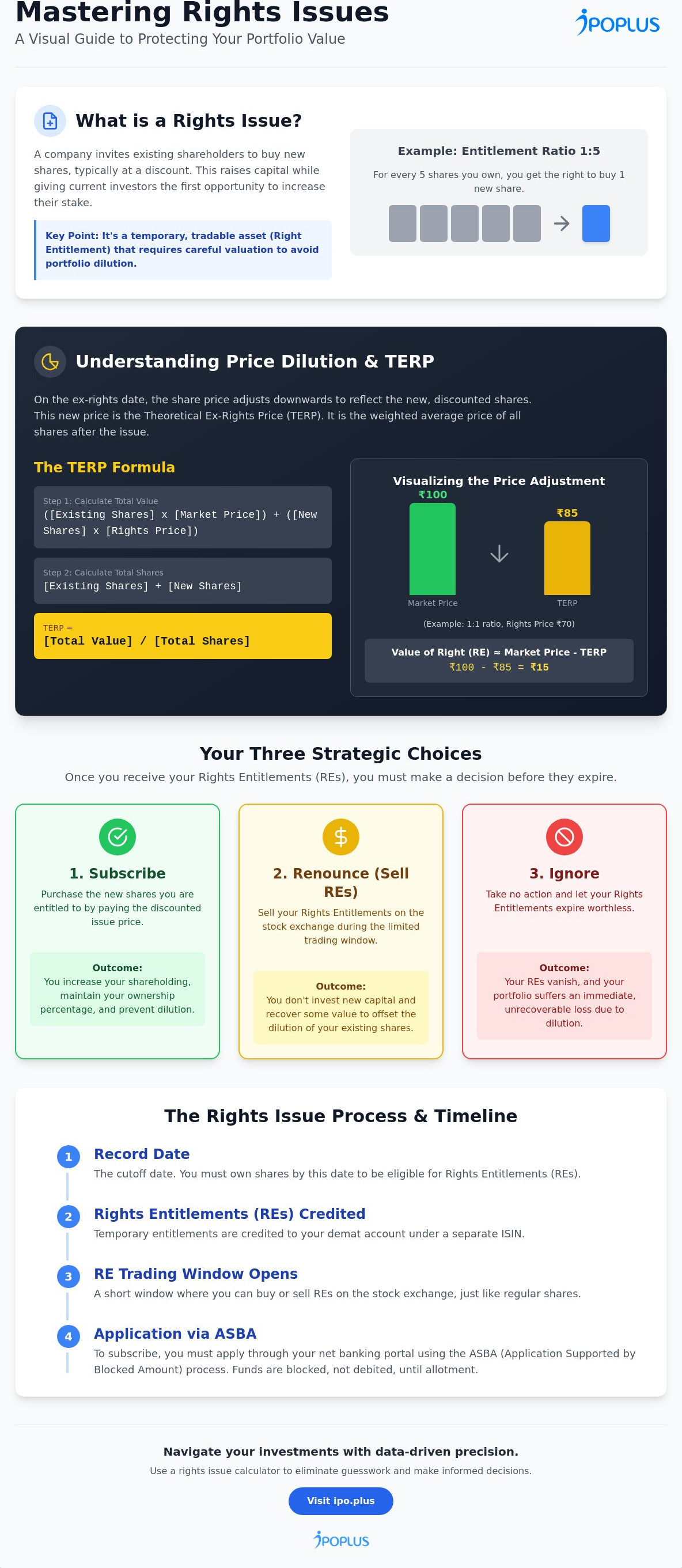
A rights issue is a corporate action where a company invites existing shareholders to purchase additional new shares, usually at a discount to the current market price. This is a secondary market offering designed to raise capital without initially involving the general public. To understand the foundational concept of how these offerings function across global markets, you can refer to this overview of What is a Rights Issue. In the Indian context, the company defines an Entitlement Ratio, such as 1:5. This means for every five shares you hold on the record date, you are entitled to buy one new share. This ratio directly dictates your future share count and the level of capital you must commit.
Eligibility for these shares depends entirely on the Record Date. Only investors who hold the stock in their demat account by this specific cutoff receive Rights Entitlements (RE). If you purchase shares after the stock goes "ex-rights," you won't receive the REs. Manual tracking of these dates and ratios frequently leads to errors in cash outlay projections. Investors often miscalculate the total funds needed for a full subscription, especially when managing fractional entitlements or holdings across multiple demat accounts. Relying on a rights issue entitlement calculator eliminates these mathematical risks and ensures your liquidity planning is accurate.
The Mechanics of Rights Entitlements (RE)
When a rights issue begins, the company credits a temporary ISIN to your demat account. These credits are your Rights Entitlements. It's vital to distinguish between holding an RE and owning the actual shares. An RE is simply a right to apply; it isn't the stock itself. These entitlements possess an intrinsic value that trades on the stock exchange during a specific, narrow window. The price of the RE fluctuates based on the spread between the current market price and the rights issue price. If you don't intend to buy the new shares, you can sell these REs on the exchange to recover some of the value lost to dilution.
Why Investors Use Entitlement Calculators
Precision is the primary reason to utilize a rights issue entitlement calculator. It determines the exact cash requirement in ₹ for a full subscription based on your current holdings. This prevents application rejections during the ASBA process, which can occur if your bank account lacks the precise amount to be blocked. Beyond simple counting, a calculator helps you visualize how the discounted pricing affects your total portfolio value. Many investors suffer a "lazy" loss by neither subscribing nor selling their REs. A calculator highlights the value at risk, helping you decide whether to invest more capital or renounce your rights for a cash gain before the entitlement expires.
Calculating the Theoretical Ex-Rights Price (TERP) and Dilution
The market price of a stock does not remain static after a rights announcement. On the ex-rights date, the exchange adjusts the share price downward to reflect the influx of new, discounted shares. This new equilibrium is the Theoretical Ex-Rights Price (TERP). It serves as the mathematical floor for the stock's value immediately following the detachment of the rights. Understanding this shift is essential when Evaluating Your Options in a Rights Issue. If the market price stays above TERP, the "Value of Right" remains positive. This value is calculated simply as the current market price minus the TERP. It represents the intrinsic worth of each entitlement credited to your demat account.
The detachment of Rights Entitlements (RE) creates a specific price gap. This gap represents the value transferred from the original share price to the new rights. Failure to account for this leads to "phantom" losses in your portfolio view. The TERP provides the baseline for the RE's intrinsic value. For example, if a stock trades at ₹100 and the rights price is ₹70 with a 1:1 ratio, the TERP is ₹85. The RE value is approximately ₹15. Without these calculations, you risk overpaying for rights or selling them too cheaply on the exchange during the trading window.
The TERP Formula Breakdown
Calculating TERP manually is prone to error due to the variables involved. A rights issue entitlement calculator automates this two-step process to ensure accuracy:
- Step 1: Multiply your existing shares by the current market price. Add this figure to the product of your new entitled shares and the issue price.
- Step 2: Divide the resulting sum by the total number of shares you will hold post-allotment.
TERP is the weighted average price of the original shares and the newly issued discounted shares. It acts as a guide for the stock's expected trading range once the rights are detached.
Understanding Portfolio Dilution
Dilution is more than just a lower share price; it affects your fundamental claim on the company. Even if your share count increases, your percentage ownership will decrease if you don't subscribe to your full entitlement. This happens because the total number of outstanding shares in the market grows. You can track these capital changes and market reactions using the IPO Tracking Dashboard to stay ahead of volatility.
- Earnings Per Share (EPS) Dilution: The company's total profit is now distributed across a larger pool of shares. This often leads to a temporary drop in reported EPS.
- Price Dilution: The market price typically falls because the new shares are issued at a discount, lowering the overall average valuation.
A rights issue entitlement calculator helps you see if the provided discount effectively compensates for this dilution. If the discount is too narrow, the risk of wealth erosion increases. Investors must determine if the company's intended use of the capital justifies the immediate dilution of their holdings.
Evaluating Your Options: Subscribe, Renounce, or Ignore?
Shareholders have three primary paths when a rights issue goes live. A full subscription involves paying the issue price for every entitled share to maintain your current percentage stake. If you don't want to commit more capital, renunciation allows you to sell your Rights Entitlements (RE) on the secondary market. There is also partial renunciation, often called "tail-swallowing." In this scenario, you sell just enough REs to fund the subscription of your remaining entitlements. This results in a cash-neutral transaction that still increases your total share count. For a baseline understanding of these corporate actions, What is a Rights Issue? offers a comprehensive overview of how these offerings function.
The "Ignore" trap is the most significant risk for retail investors. Doing nothing is a guaranteed financial penalty. Because the stock price typically drops toward the TERP on the ex-rights date, your existing holdings lose value. If you don't subscribe or sell the RE, that value isn't recovered. It simply vanishes. Using a rights issue entitlement calculator helps you quantify this potential wealth erosion in ₹ before the window closes. It provides the data needed to decide which path protects your portfolio's net worth most effectively.
Trading Your Rights Entitlements (RE)
The RE trading window is narrow. It usually opens with the issue launch but closes 3-4 days before the official issue closing date. You can trade REs through your standard trading terminal just like regular equity. Since these entitlements are credited to your demat account at zero cost, the entire sale proceed is generally treated as short-term capital gains (STCG) under Indian tax laws. Don't wait until the final day to sell; liquidity often dries up as the deadline approaches, leading to wider bid-ask spreads.
Handling Fractional Entitlements
Ratios often result in decimals. If a 1:7 ratio applies to your 10 shares, you're entitled to 1.42 shares. Indian regulations typically mandate rounding down to the nearest whole number for the basic entitlement. You won't receive 0.42 shares. However, you can still apply for "additional" shares in the application form to account for these fractions. The rights issue entitlement calculator on the IPO Plus platform automatically handles these rounding rules. It shows your confirmed whole-share entitlement and helps you estimate the cash required if you choose to bid for additional shares during the allotment process.
How to Use the IPO Plus Rights Issue Calculator
Access the rights issue entitlement calculator through the IPO Tracking Dashboard or the IPO Plus Android App. This tool is designed for speed and functional clarity. It aggregates multiple data points into a single actionable view. You only need four primary variables to generate a complete valuation report. Start by entering the Current Market Price and the Rights Issue Price found in the company's official announcement. Next, input the Rights Ratio by filling in the numerator and denominator fields. The system immediately processes these inputs to provide your entitlement count, total subscription cost, and the projected TERP.
Using the calculator eliminates the risk of manual calculation errors that often lead to rejected ASBA applications. It serves as a central hub for your application planning, allowing you to run multiple "what-if" scenarios. For example, you can adjust the Current Market Price to see how volatility affects the intrinsic value of your Rights Entitlements (RE). This real-time utility is essential for traders looking to exit RE positions before the trading window closes.
Data Inputs for Accurate Results
Official ratio data is located in the Letter of Offer (LOF). Companies file this document with SEBI and the stock exchanges before the issue opens. Verify the ratio here to ensure your inputs are precise. When using the calculator, distinguish between "Cum-Rights" and "Ex-Rights" prices. Use the Cum-Rights price for pre-issue planning. Use the Ex-Rights price once the stock has adjusted to track the live value of your entitlements. Ensure you enter your holding exactly as it appeared on the Record Date. Shares purchased after this date won't generate Rights Entitlements.
Interpreting the Calculator Results
The output identifies the exact Total Investment required. This is the specific amount in ₹ that must be available in your bank account for the ASBA block. The calculator also reveals the Effective Discount. This percentage represents the difference between the TERP and the Issue Price. It provides a more accurate view of the value proposition than the market price alone. Use the calculated TERP as a benchmark for your post-issue exit strategy. If the stock trades significantly below the TERP after allotment, it may indicate market bearishness despite the discounted offering.
To begin planning your next application and avoid portfolio dilution, visit our Financial Calculators section for instant access to these tools.
Final Steps: Applying for the Rights Issue via ASBA
The Securities and Exchange Board of India (SEBI) mandates the Application Supported by Blocked Amount (ASBA) process for all rights issues. There is no provision for physical paper applications. This digital-first approach aligns with the 2025 regulatory shift that compressed the rights issue timeline to just 23 working days. For retail investors, net banking remains the most reliable channel for execution. If your application value is below ₹5 Lakhs, you can also utilize the UPI payment mechanism through supported third-party apps. The funds stay in your account but are blocked, ensuring you continue to earn interest until the allotment date.
Efficiency is critical during this phase. Since the trading window for Rights Entitlements (RE) closes several days before the issue itself, you must finalize your decision early. Use the data from the rights issue entitlement calculator to confirm your total cash commitment before initiating the block. This prevents last-minute liquidity issues that could lead to a failed application. Once the bank blocks the funds, you'll receive an SMS confirmation from the exchange, signaling that your bid is successfully registered in the system.
Step-by-Step ASBA Application
Executing the application takes less than five minutes through most Indian bank portals. Follow this structured workflow for a seamless experience:
- Log in: Access your net banking portal and navigate to the "Investment," "IPO," or "ASBA" section.
- Select Issue: Locate the specific rights issue from the list of active corporate actions.
- Enter DP Details: Input your 16-digit DP ID. Ensure you select the correct depository (CDSL or NSDL) as per your demat profile.
- Specify Quantity: Enter the exact number of shares you are subscribing to. Use the figure provided by the rights issue entitlement calculator for your basic entitlement.
- Confirm: Review the ₹ amount to be blocked and authorize the transaction using your transaction password or OTP.
Post-Allotment: Listing and Trading
After the application window closes, the company proceeds with the allotment. You can track the status through the registrar's website using your PAN or DP ID. Once allotted, the temporary RE ISIN disappears from your demat holdings. It is replaced by the permanent equity shares of the company. These new shares are fungible with your existing holdings and trade under the same ticker on the NSE and BSE.
Finalize your participation by conducting a portfolio review. Compare the actual market listing price of the new shares against your previously calculated TERP. This comparison reveals the immediate "paper profit" or loss resulting from the issue. If the market price holds above your TERP, the discount has successfully buffered you against the impact of dilution. This methodical approach ensures you transition from an entitlement holder to a full shareholder with complete financial clarity.
Maximize Your Rights Issue Participation
Managing a rights issue requires more than just capital; it demands mathematical precision. You've learned that calculating the Theoretical Ex-Rights Price (TERP) is the only way to measure the true impact of dilution on your holdings. Ignoring the Rights Entitlement (RE) trading window often leads to unnecessary wealth loss. By mastering the ASBA process and understanding the 23-working-day regulatory cycle, you position yourself to act with confidence. A rights issue entitlement calculator serves as your primary tool for validating these complex variables before you commit funds.
Data accuracy is the foundation of successful market participation. IPO Plus provides real-time tracking of Indian corporate actions and accurate TERP modeling to help you stay ahead. Our platform is currently used by over 500,000 retail investors to simplify their decision-making process. You can access these insights and secure your portfolio value by using our specialized tools today. Don't let technical complexity or tight timelines erode your investment returns.
Calculate your rights entitlement on the IPO Plus App to ensure your next application is data-driven and precise. Stay vigilant and use the right data to turn corporate actions into strategic opportunities for your portfolio.
Frequently Asked Questions
What is the Rights Entitlement (RE) in an Indian rights issue?
Rights Entitlement (RE) is a temporary credit issued to shareholders in their demat accounts representing the privilege to subscribe to new shares. It trades on the stock exchange under a unique ISIN during a specific window. This allows shareholders to either exercise their right to buy discounted shares or sell the entitlement to another investor. It carries an intrinsic value based on the spread between the market price and the issue price.
How do I calculate the number of rights shares I can buy?
You calculate your entitlement by multiplying your shares held on the record date by the offer ratio. For a 2:7 ratio, holding 70 shares entitles you to 20 new shares. Using a rights issue entitlement calculator is the most efficient way to handle these calculations, especially when dealing with fractional rounding rules. This ensures you have the exact count required for your ASBA application and cash management.
What happens if I do not take any action on my rights entitlement?
Doing nothing results in the total loss of the Rights Entitlement's value and significant portfolio dilution. The REs credited to your account expire worthless once the issue closes. Since the stock price typically drops toward the TERP on the ex-rights date, failing to subscribe or renounce means your portfolio value decreases without any offsetting cash gain or share increase. It is the least efficient financial choice.
Can I apply for more shares than my entitlement in a rights issue?
Shareholders have the right to apply for additional shares beyond their basic entitlement. While your basic entitlement is guaranteed, additional shares are allotted based on the availability of unsubscribed portions from other investors. A rights issue entitlement calculator helps you determine the total ₹ amount to block in your bank account if you choose to bid for more than your allocated limit during the ASBA process.
Is it mandatory to use ASBA for rights issue applications?
ASBA is the only permitted method for applying for a rights issue in India as per SEBI regulations. Physical applications or cheque payments are no longer accepted for these corporate actions. Investors must use net banking or UPI for amounts up to ₹5 Lakhs to block the application funds. This process ensures transparency and speeds up the allotment cycle to the current 23-working-day standard.
How is the TERP different from the current market price?
TERP is a calculated weighted average price, while the current market price is the live trading value before the issue adjustment. The market price includes the value of the "right," whereas the TERP represents the expected price after that right is detached on the ex-date. The difference between the two represents the intrinsic value of the Rights Entitlement. It provides a benchmark for the stock's performance post-allotment.
Can I sell my rights entitlement to someone else?
You can renounce your rights by selling the RE units on the stock exchange trading terminal like regular shares. This process is called "on-market renunciation" and must be completed before the RE trading window closes. Alternatively, you can perform "off-market renunciation" by transferring the REs to another person's demat account via a delivery instruction slip (DIS) before the issue closing date to recover the entitlement's value.
Where can I find the record date for an upcoming rights issue?
The record date is available in the Letter of Offer (LOF) and the company's corporate filings with the NSE and BSE. It determines which shareholders are eligible to receive the Rights Entitlements in their demat accounts. You can monitor these critical dates and other corporate actions through the IPO Plus dashboard. This ensures you don't miss the cutoff for eligibility and can plan your application strategy in advance.