
markets14 Jun 2026, 2:19 pm
Decoding Stock Ratios: Your Guide to P/E, ROE, ROCE, D/E, and Book Value
By IPO Plus Desk
Understanding key stock ratios is crucial for Indian retail investors to make informed decisions about companies listed on exchanges like the NSE and BSE.
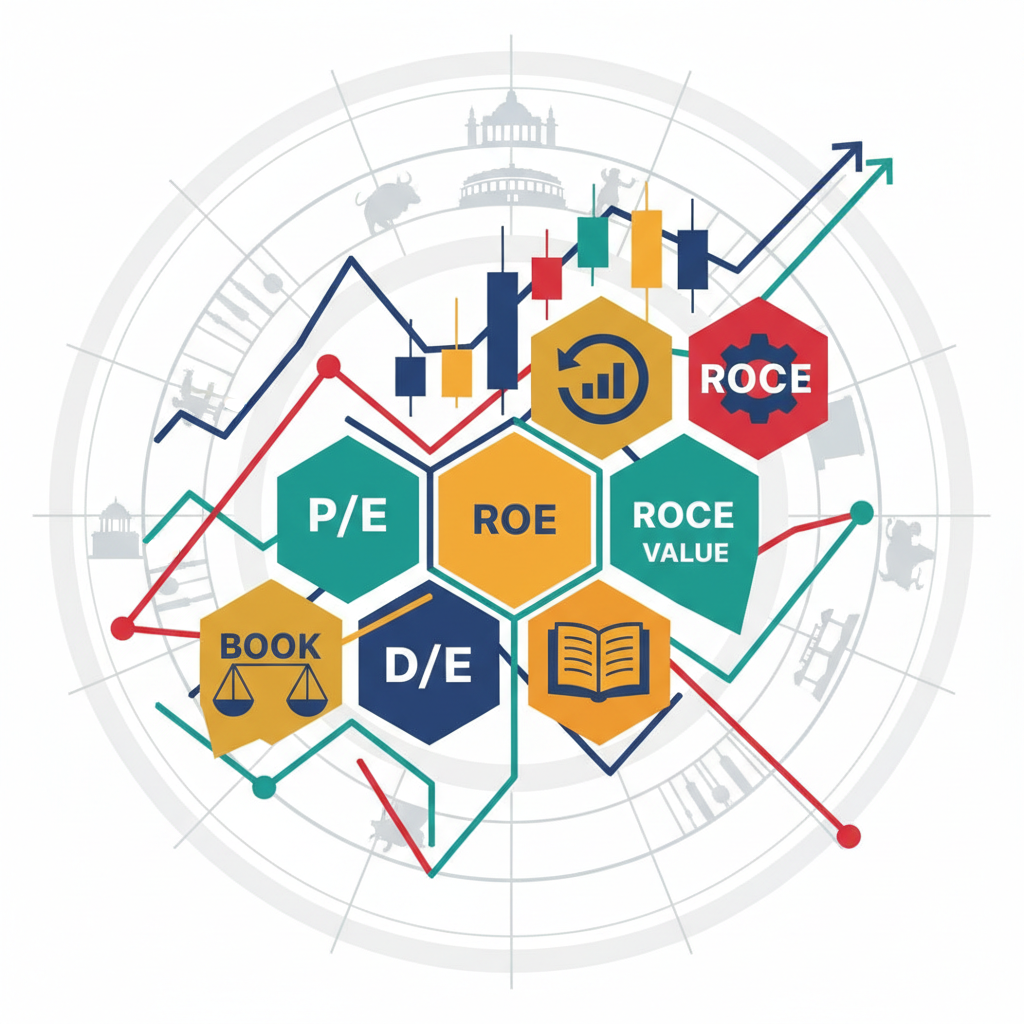
As an Indian retail investor, you'll encounter various financial ratios that help evaluate a company's health and potential. These ratios, derived from financial statements, offer a snapshot of a company's performance, efficiency, and financial structure.
**Price-to-Earnings (P/E) Ratio:** This popular valuation metric compares a company's current share price to its earnings per share (EPS). A high P/E ratio can suggest investors are willing to pay more for each rupee of earnings, implying growth expectations, while a low P/E might indicate an undervalued stock or a company with slower growth prospects. It's often compared against industry averages or historical P/E for better context.
**Return on Equity (ROE) & Return on Capital Employed (ROCE):** ROE measures how much profit a company generates for each rupee of shareholders' equity. It indicates management's efficiency in using shareholder funds. ROCE, on the other hand, measures how well a company is generating profits from all its capital, including both equity and debt. Both are crucial profitability indicators, with higher ratios generally preferred.
**Debt-to-Equity (D/E) Ratio:** This ratio indicates the proportion of a company's financing that comes from debt versus equity. A high D/E ratio means the company relies heavily on debt, which can increase financial risk, especially during economic downturns or rising interest rates. A lower ratio generally suggests a more conservative and financially stable company.
**Book Value Per Share:** This represents the net asset value of a company on a per-share basis. It's calculated by subtracting liabilities from assets and dividing by the number of outstanding shares. While it doesn't reflect market value, it can provide a baseline for a company's intrinsic worth and is particularly relevant for asset-heavy companies or for assessing a company's liquidation value.
Remember, no single ratio tells the whole story. It's vital to analyze these ratios in conjunction with each other, consider industry-specific benchmarks, and understand the company's business model and future prospects for a holistic investment decision. Always conduct thorough due diligence.